Friday, November 11, 2011

Bio-Reference Labs (NASDAQ:BRLI): Jefferies throws in the towel..

Bio-Reference Labs (NASDAQ:BRLI) a lab testing company currently under siege from short-sellers at Streetsweeper.org appears to be losing Sell side analyst support this morning after Jefferies & Co decides to put their rating Under Review (prev. Hold).


- Jefferies analyst Arthur Henderson notes they expect BRLI shares to see increased pressure after a second short report, published on Thursday afternoon, criticized the company's business practices and the background of certain employees. While they have no reason to believe the company has done or is doing anything inappropriate or unethical, the firm believes the news will not be well received and could elicit scrutiny from regulators. Rating under review (from Hold).


The details:

The Street Sweeper strikes again. On Thursday afternoon, The Street Sweeper, an online research organization whose goal is "to uncover the dirty little secrets that investors need to know," released the second part of its investigation into BRLI's business practices. The report digs deeper into BRLI and discusses the alleged sordid background of a few current and former employees. As a reminder, the first report was issued on November 1st and raised concerns about the viability and sustainability of BRLI's earnings growth, which has been fueled in part by increased utilization of the company's GenPap test -- a sophisticated test allowing OB/GYNs to better screen and detect a wide range of organisms such as chlamydia, gonorrhea, syphilis, etc. That report also articulated concerns about the company's billing practices, its weak cash flows, and salesforce tactics.

A new overhang emerges for BRLI. The Street Sweeper report is definitely an eyeopener and could spook investors as well as draw the attention of regulators. While we have no reason or evidence to conclude that the company or its employees have done anything unethical or inappropriate, the allegations are poignant and could provide a meaningful overhang on BRLI shares.

Notablecalls: Well this is alarming. I expected a garden variety Sells side defense but not this.

With Henderson calling the Sweeper report an 'eyeopener with potential to draw regulatory attention' I would not be surprised to see the stock in free fall.

Note there's 28% short interest in the name.


Here are the reports:

Is Bio-Reference Laboratories as Healthy as It Seems?

Bio-Reference (BRLI): Loads of Dirty Laundry


Thursday, November 10, 2011

Actionable Call Alert: Green Mountain Coffee (NASDAQ:GMCR) - Bounce?

Geen Mountain Coffee (NASDAQ:GMCR) trading down 30%+ following results and guidance reported last night.

- Most analysts are defending the name.

- Canaccord analyst Scott Van Winkle highlights something I would like to share with you:

'...A bear would argue that our (positive) opinion is shaded by our rose colored glasses. Well, we heard people saying the exact same thing in the exact same situation in Hansen Natural (HANS : NASDAQ : $90.09 | HOLD) in May 2010. We remember this so clearly because the HANS correction last May was the greatest buying opportunity we have ever seem on a timing issue around a price increase and the greatest miss we have ever had as a sell-side analyst. HANS instituted a price increase in January 2010 that led to massive buying by distributors ahead of the increase and even though the company knew there was a channel load, it didn’t realize how significant the buy-ahead was. Sound familiar? The result was that HANS crushed Q4/2009 results and then missed the subsequent Q1/2010 estimates by an even wider margin than GMCR’s relatively modest miss last night. HANS shares plummeted from near $45 to as low as $25 intraday.

The stock plummeted on an apparent slowing. Yet, third-party data from the likes of Nielsen and IRI continued to show robust growth at point of sale. Sound familiar? GMCR just put up a figure that will lead some investors to think business is slowing. It isn’t, in our view, because the third-party data from the likes of Nielsen and IRI, but more importantly NPD on brewers, show continued growth and even accelerated growth of brewers. For those who follow consumer staples, we don’t need to remind you what happened next with HANS. It is obvious in hindsight. Growth continued, shipments caught back up to the sell-through data in the next quarter, and HANS went on an extended rally to close yesterday at $90.09 ($97.31 is the recent high). If you dumped HANS on the miss, you missed a triple. This may not sound familiar yet for GMCR, but we expect it will....'

Notablecalls: Just draw your own conclusions. Calling it Actionable Call Alert!


"History doesn't repeat itself, but it does rhyme."

-- Mark Twain

Wednesday, November 09, 2011

Dreamworks (NYSE:DWA): Renewed Optimism Creates Selling Opportunity – Downgrading To Sell, $12 PT - Janney

Janney's Tony Wible is dealing a potential death blow to Dreamworks Animation SKG (NYSE:DWA) downgrading the name to Sell from Hold while lowering his price target to Street low of $12.

According to Wible they are increasingly concerned about the decay in franchise film performance, the possible cannibalization from the NFLX deal, the weak open on Puss in Boots, and their diminished outlook on new IP films. These concerns are exacerbated by the steep decline in DWA's DVD sales, but is partly tempered by better international performance, the near term boost from NFLX catalog sales, strong non-film performance, and the potential for self distribution savings in 2013. On balance, Janney believes estimates will need to move lower and sees the risk/reward on the stock in favor of a Sell rating.

KEY POINTS:

Downgrade on Spike and Optimism - We are downgrading DWA to Sell from Neutral, as we believe the street is too optimistic about the rebound prospects on Puss In Boots, which we believe is now trending towards a $135 million USBO ultimate (below our reduced expectations). The under performance leads us to question the prospects on DWA's future slate of new IP films. We are reducing our fair value to $12 based on the reduction in our estimates.

Lower Generic Expectations - We believe the generic $200 million USBO film will trend down to $175 million. While foreign performance has helped worldwide numbers, the high rental rates offset much of the benefit. Our reduction of Puss In Boots numbers and the reduction in new IP film estimates (Guardians, Croods, Turbo, Shadow) lead us to reduce our 2012 and 2013 EPS to $1.07 and $0.95 from $1.41 and $1.50, respectively.

Franchise Fatigue - The core of DWA's business has been under pressure as established franchises are decaying faster than expected while new IP films have yet to create new franchises. The company is still producing some of the highest grossing animated films but the relative weakness and the string of disappointments will likely cast more doubt over future releases. Mounting competition also stands to commoditize the value of DWA's IP.

DVD Doubts - The entire industry has seen weakness in disc sales. However, DWA's compression in DVD to Box office ratios have been higher than its peers, which we ascribe to its support of cheap rental services. While the new NFLX deal will provide incremental catalog revenue near term, this deal has the potential to cannibalize new release and catalog disc sales as the output deal launches in 2013.

Foreign Exchange - The recent strength in the USD could be another headwind for DWA, as it produces its films in USD but sees more than half its revenue from international markets. The high USD would essentially deprive DWA of high margin revenue. While P&A spend is a hedge, each DWA film is expected to be profitable so the hit to revenue will be greater than the expense offset. We would note there has been recent weakness in key Latin American currencies that are now trending between a 4% to 8% YOY headwind.

One Last Hurrah - Puss will likely rule the USBO for one final weekend and may gross between $25 to $35 million, which could fuel more bullish optimism. However, Puss's run is coming to a close as Happy Feet 2 launches next week.

Notablecalls: So who is Tony Wible from Janney you ask? The guy who nailed (or killed) Netflix.

- April 26, 2011: Headwinds Trump Momentum – Downgrading To SELL

- Oct 10, 2011: Upgrade to Hold

- Oct 25, 2011: Downgrade to SELL with $51 PT


And now it appears he is going after DWA with similar vigor, cutting PT and estimates way below Street.

This alone should send tremors down the holders' spines.

DWA should get hit after open and then drift down in the n-t, possibly below $18 level.


PS: I'm posting this around open.

Wednesday, November 02, 2011

Career Education Corp. (NASDAQ:CECO): Ugh..

Career Education Corp. (NASDAQ:CECO) literally shit the bed last night as the co issued a slew of announcements this evening, including 1) the resignation of CEO Gary McCullough, 2) an update on its internal investigation into placement rates, and 3) its third-quarter results (a week earlier than expected). Board chairman Steven Lesnick has been named CEO while the board conducts a search for a permanent replacement.

CECO revealed that 36 of its 49 ACICS-accredited Health Ed and Art & Design schools failed to meet minimum accreditation standards for its placement rates in 2010-2011.

I've seen 3 downgrades so far but I'm quite sure more will follow after the 8:30 AM ET conference call concludes:


- William Blair is lowering CECO to Underperform saying that given 1) the likelihood that estimates will come down a lot for 2012 and 2013, 2) the chance of a material fine/settlement could occur, and 3) visibility on a recovery in starts for every franchise but the international business, it is difficult to value (in other words where would the stock be a buy) the enterprise with traditional metrics. On a rough sum-of-the-parts basis, (no value for Health or A&D, $50 million to $150 million in legal liabilities or fines, and $300 million in teachout cash flow losses over 2 years at Health and A&D) they believe the stock is worth probably $10 and $12, but a lot of that value depends on what 2012 profits in the University segment are; hopefully they will get a better feel for that on Wednesday’s call.

- First Analysis cuts CECO to Underweight noting they believe the independent counsel has not yet completed its investigation into the company's other segments, suggesting additional issues may still be uncovered. AIU and CTU are regionally accredited and thus don't have to report placement-rate data to their accrediting body (the Higher Learning Commission), though they believe they have provided placement data to prospective students, potentially exposing them to other legal and regulatory risks if the data proves to have been inaccurate.

Firm expects Career Education's stock will trade down meaningfully today. However, given the difficult-to-quantify and potentially substantial nature of the issues noted above, they find it difficult to recommend even investors with a deep value focus take a meaningful position in the stock at present.

They believe other names in the sector may trade down as well as investors ask whether others could have similar issues. Firm reminds investors that many of the companies in their coverage universe are regionally accredited and don't purport to offer placement services, much less report placement rates to their accrediting bodies. (These include Apollo, American Public Education, Capella, Strayer, and institutions at non-covered companies Bridgepoint and Grand Canyon. DeVry University is also regionally accredited, and while it does provide graduate employment data to students, First Analysis is confident in DeVry's internal controls.) They also believe nationally accredited schools that have grown organically, such as ITT and UTI, have operational controls in place to prevent such issues. Finally, they note that while Career Education's announcement may provide another arrow for Senator Harkin's quiver in his campaign to further clamp down on the sector, the placement-rate question isn't a new one, and a hearing he held in September 2010 was on precisely this topic.


- Stifel cuts to Hold from Buy noting that while an earnings and enrollment miss in this very challenging environment is not shocking, their original Buy thesis was predicated on the sum of the parts being greater than the enterprise value, improving academic quality, and progress being made by a relative newer management team. While progress was made on several fronts, the board’s decision to accept the CEO’s resignation in light of recent allegations of inflated placement rates in the health care division suggest lacking integrity in disclosed metrics. As such the firm believes the stock will be in the state of limbo for the foreseeable future. They therefore feel compelled to move to the sidelines until the management situation is clarified/resolved.

- CSFB says they expect shares to face significant pressure this morning.

- Baird says they expect CECO to trade down today.

- Morgan Stanley notes they expect shares of CECO to decline sharply as investors come to terms with the CEO’s sudden departure, findings by outside counsel of improper placement practices, and pre-reported weak Q3 results. CECO has a history of accreditation issues and in the current environment, in which accrediting bodies have been under pressure to better police the industry, they do not expect this to be handled with leniency. Firm notes though that this issue appears to be CECO specific and while the whole group is likely to trade off, they would view this as a buying opportunity for companies with better records of regulatory compliance.

Notablecalls: Reading the PR, all I could think was 'is this going to single digits now?'

Utter clusterf*ck and this could get worse as the independent counsel completes its investigation. Note the 49 colleges investigated represent around 40% of CECO revenues. So there could be more to come.

CECO has 6 bucks of cash per share on the balance sheet, which should limit the downside to $9-10 level.

This could hurt the entire sector. It's unlikely CECO is alone in this with its placement issues.

Thursday, October 27, 2011

Acme Packet (NASDAQ:APKT): Positive checks on Tier-1 VoIP Platforms opportunity - Deutsche

Deutsche Bank's Wireless Eq. team is making an interesting call in Acme Packet (NASDAQ:APKT) saying their latest round of industry checks have meaningfully improved their conviction on the Tier-1 VoIP Platform deal consummation for Acme in Q4.

Further, their checks suggest potential for meaningful upside to Acme's runrate SBC business in Q4, especially from large enterprise SBC deal closures. The SBC pricing and competitive environment remains benign in firm's view, with no meaningful near-term share gains from Acme's competitors (Alcatel Lucent, Genband, Sonus, Cisco etc).

- Firm is adding APKT to their s-t Solar Buy List.

The details:

See upside to Q4 and FY12+ view
Lack of clarity from management regarding the pending Tier-1 VoIP platform award (management guiding to sometime in 1H Q4 for closure of the deal, versus confirming the deal closure, during last week's earnings call) has been a major overhang on the stock, with bears pointing to potential for growth moderation across multiple segments of Acme's business, in addition to potential for the VoIP deal to slip into FY12. We disagree with the bear-case thesis (playing out in the stock somewhat, at current levels) and instead articulate a bullish view on Acme's Q4 and on their FY12+ growth opportunities, based on our latest checks and our view of Acme's market leadership position in the SBC market. Even a slight upside to the $93 m Q4 consensus expectation is likely to be cheered by investors, given that it represents the company's ability to successfully carry $100 m quarters in FY12+ (from an operational and sales execution point of view).

Reiterate our Buy rating
We fundamentally believe that major initiatives such as: 1) carrier VoIP platforms; 2) enterprise SIP trunking; 3) IP session recording; 4) telco and cableco VoIP peering etc., are the next phase of growth opportunities for Acme. We see favorable risk/reward at current levels (stock implying a +20% FY12 growth rate versus our +28% estimate). We reiterate our Buy rating.

Notablecalls: APKT was the (the!) momentum name of 2010 and 2011 as it went from sub $10 to $85.

Now it has given back 2/3 of that in just 4-5 months as the market crumbled and shorts smelled blood in form of AT&T's VoIP platform delays.

The management did a terrible job explaining (or rather not explaining) the delays around last qtr, causing another 20% haircut in the stock price.


Yet now we have Brian Modoff from DBAB saying his intel points to AT&T contract coming through. Also, the SBC business appears to be running strong.

This is a gutsy call. He must know something.


The stock should move up. This could cause a 7-10% move in the n-t.

Friday, October 21, 2011

Actionable Call Alert: Green Mountain Coffee (NASDAQ:GMCR)

SunTrust analyst William Chappell is literally pounding the table on Green Mountain Coffee (NASDAQ:GMCR) saying short seller David Einhorn is utterly wrong with his short thesis on the stock.

- Firm strongly reiterates Buy and adds to Top Pick status with $120 price target.

Chappell notes that Einhorn used their research reports (without their permission) as the basis for his negative conference presentation against GMCR. The report was made publicly available on Wednesday and the firm has since had a chance to “dissect his dissection” of their positive investment thesis.

- While there were no surprises in the presentation, the analyst does want to address several errors and omissions in that report to clarify his case. First, they remain comfortable in their $9 EPS analysis vs. his $3.50 estimate. The major errors to his math come on the “profit to split” analysis in which he appears to double-count the packaging costs, and his assumption for 20% private label share in k-cups, a penetration level which we will explain below to be STATISTICALLY impossible. Suntrust also notes that neither their $9 estimate, nor his $3.50 estimate, include potential profits from the highly profitable away from home segment.

Here are couple of examples of Chappell's counter:

Questioning the Starbucks Economics (slides 32 to 37)—As GMCR has previously said, it will make the same penny profit per k-cup on its brands as it will on partnered brands such as SBUX and Dunkin’ Brands. According to the investor, SBUX has said that it will make 2/3 of the profit and GMCR will make 1/3 of the total profit on each cup which, for the sake of argument, we will assume is correct. The problem lies in the investor’s math. Based on slide 35 he indicated that the total potential profit to share (i.e. split 2/3 to 1/3) is $0.22/k-cup. However, his analysis includes the assumption that BOTH companies will be paying $0.15/k‐cup for packaging when, in fact, SBUX is paying GMCR for the packaging services. If we eliminate this double‐count and assume that the cost of packaging is closer to $0.04-$0.05 per k-cup (based on prior statements by GMCR), the total profit to split is closer to $0.33/cup. If we then say that GMCR only takes a 1/3 of that profit per cup it would equate to $0.11, which is in line with our prior math.

Before leaving this item, we point out that, in our opinion, SBUX needed the GMCR partnership. Over the past decade, consumers were able to purchase single serve SBUX coffee through Kraft’s Tassimo system. But consumers overwhelmingly chose GMCR’s Keurig system (70% + market share of single serve system) vs. Tassimo (6% share), despite not having the option of SBUX. Additionally, SBUX only holds a 7-8% market share of coffee sold at retail and has been looking for new ways (i.e. Via) to expand that share. Again, we believe SBUX will still make more than $0.20 per k-cup so we doubt it looks at this as a bad bargain.

Private Label 20% Share Statistically Impossible (slides 63 and 66)—The second major driver of his $3.50 estimate is the assumption that non‐licensed private label cups will account for 20% of the total k‐cups sold. This comes from a quote from a “beverage Industry expert”. First, there are NO beverage categories outside of water and milk in which private label consists of 20% of the market. Second, private label only accounts for 10% of coffee sold at grocery, a level that has not deviated more than 1% per year for the past 10 years. That means it would take at least a 10‐standard deviation move to get to 20%; statistically impossible in the next five years.

- Second, Suntrust believes the implication that the company may have committed some sort of accounting fraud is a form of double jeopardy. While they do not outright reject the statement of a disgruntled M-Block employee from a six month old shareholder lawsuit, this statement relates to sales made in December 2009 and neglects to mention that GMCR already restated its financial results for FY08, FY09 and FY10 after a thorough review of the accounting.

In short, Chappell remain as confident as ever in the GMCR story and has moved it to their Top Pick among the 21 stocks he covers.

Notablecalls: This seems big as SunTrust's Chappell is countering Einhorn's claims with solid info and numbers. Not your typical 'We believe blah..blah..blah' type of defend we tend to get from the sell side.

Moreover, Einhorn used their models to present his short case. It appears he may have been wrong.

The stock is down 47 pts from its Sept highs, half of that over the past 4 days as funds managers blew out the name not to look stupid.

Greenberg was on CNBC yesterday, which probably attracted the retail shorts. They will get squeezed today. Big time, I suspect.

Given the nature of GMCR I would not be surprised to see it up 6-7 pts on this, putting 74-75 levels in play.

The shorts will have hell of a time keeping this one down.

I'm call this one Actionable Call (trading) Alert!

Thursday, October 20, 2011

Baidu (NASDAQ:BIDU): Take profits after 1000% run - Goldman Sachs

Goldman Sachs is making a major call in Baidu (NASDAQ:BIDU) downgrading the name to Neutral from Buy with a $165 price target (prev. $175)

According to Goldman fears over a China hard landing and global recession have led to a broad de-rating of the Internet and Education sectors over the past month. Although the sector has already bounced off the early October lows, with their coverage universe up 19% over the past two weeks but still down 12% over the past one month, they believe that volatility and uneasy sentiment over the sustainability of the current rally is likely to persist.

Given concerns over China’s economic slowdown next year, investors’ focus has naturally transitioned to the 2012 outlook from near-term fundamentals, with the upcoming 3Q results season unlikely to be sufficient to sustain rallies in the stocks, in Goldman's view. While they believe a managed, soft landing is more likely than a hard landing, nevertheless the lack of visibility into 2012 will likely limit share price performance.

THE DETAILS (Baidu):

The stock is up 1021% since we upgraded it to Buy on Dec 15, 2008, versus the S&P500 up 41%. While we continue to view favorably Baidu’s improved quality of growth and immense revenue opportunity as e-commerce growth accelerates advertiser adoption, we believe that relative outperformance hereon could be difficult. We consider the weakening advertising environment, which could affect Baidu at the margin despite structural growth drivers from rising online and search advertising adoption, and search as (one of, if not the) highest-ROI advertising channel.

We believe Baidu could be continued to dogged by several concerns: 1) SME tightening concerns, based on reports of lending restrictions plus rising labor costs causing bankruptcies. Looking at Baidu’s top advertiser categories, we would think some segments such as machinery and business services would be more sensitive to the economic cycle and depend on more capital-intensive industries. 2) ecommerce ad spend slowdown. Our channel checks suggest that smaller e-commerce companies are moderating their advertising spend into 4Q11 and likely into 2012 in order to conserve cash, due to heated competition and volatile capital markets hindering fundraising activities.

Baidu will report 3Q11 results on Oct 27 after the market close. We believe risk-reward could be negative going into results, given the strong fundamental momentum the company has already enjoyed boosting near-term expectations, while visibility into 2012 remains limited (with Baidu actually having the lowest visibility among our covered advertising companies owing to its large SME customer base).

Notablecalls: This will likely hurt as Goldman has been one of the most vocal bulls in Baidu. They have played their hand very well and are now telling clients to cash in the chips.

What I like about this call is that the analyst is not pushing her views, but rather attempting to be quite objective. Acknowledging the risks. Saying reward here is not worth the risk. Saying sell ahead of #'s.

This is the type of call that creates selling pressure for days as large clients sell.

I'm thinking BIDU goes below $120 level, possibly towards $118-$119 on this in the n-t.

Wednesday, October 19, 2011

Range Resources (NYSE:RRC): Cut to SELL, takeover unlikely - Canaccord

Range Resources (NYSE:RRC) the recent high-flying Marcellus play is getting downgraded at Canaccord to SELL from Hold with a $60 price target (prev. $61)

According to Canaccord, over the past month, RRC has outperformed the sector by over 20% on apparent takeout speculation. They believe RRC reflects a ~30% buyout premium even though a buyout in their view seems increasingly unlikely. RRC trades at a 14x firms ’12 EBITDA estimate – an almost 140% premium to the sector.


THE DETAILS:

As Range should spend ~60% beyond cash flow next year, we see little potential to accelerate value creation further within the current equity capitalization. The bull case is that the company’s assets are worth more in the hands of a better-capitalized enterprise.

However, we believe Marcellus activity is governed by infrastructure, not capital. In southwest Pennsylvania, limited ethane capacity should preclude further acceleration in liquids-rich production until ’14. In northeast Pennsylvania, a material increase in dry gas activity appears incompatible with the acute regional pipeline constraints.

In time, the Utica Shale is likely to compete with the Marcellus, further amplifying regional price degradation and infrastructure constraints. Based on our conversations, one reported suitor may already have too much on its plate given its previous Appalachian Basin acquisition. Additionally, that same reported buyer all but denied the talk.

Range should exhibit 3% production growth in ’11. Our ’12 production growth estimate of 43% is significantly above company guidance of 25-30%.

Notablecalls: RRC has been on tear of lately helped by all sorts of takeover rumours and results that revealed better than expected production.

The thing is up almost 50% from its Oct 4 low.

Now we have Canaccord throwing cold water on the takeover speculation saying potential suitors have already too much on their plates. It appears one one the suitors denied their interest outright.

Yet the thing trades like it's going to be taken over any moment now.

Don't get me wrong, RRC seems like a powerful Marcellus story that may have legs for the next 10 years. It's just that the stock may have gotten somewhat ahead of itself.

One to watch on the short side in the n-t. Could trade below $70 level once the fast money bails.

RRC has a history of doing secondary offerings so I wouldn't be surprised if we saw one with the stock so strong of late.

Wednesday, October 12, 2011

First Solar (NASDAQ:FSLR): Ticonderoga cuts to Sell with $40 PT

Ticonderoga's Paul Leming is making a very negative call on First Solar (NASDAQ:FSLR) downgrading the Solar leader to SELL from NEUTRAL with a $40 price target (prev. $117)

According to the analyst there will be acceleration into the downside in both pricing and volume expectations for the PV industry.

THE DETAILS:

No Year-End Rally In Germany - Phoenix Solar yesterday announced sharply lower revenue expectations for 2011 and stated bluntly in their press release that "the hitherto expected year-end rally [in installations in Germany] does not appear to be materializing." Germany remains the single largest market in the world for PV - the lack of a fourth quarter surge in installations and the growing support for still further reductions in subsidies in Germany is devastating news for the PV industry in general and FSLR, in particular. Volume assumptions for 2012 are increasingly at risk.

Pricing Declines Accelerating - Pricing throughout PV value chain appears to be accelerating to the downside; consistent with: 1) Disappointing Q4 volumes; 2) Massive overcapacity throughout the value chain and 3) The reality that still weaker volumes in the seasonally soft first half of the year (2012) will soon become a reality in the industry. Thin-film module prices are now at or below 90 cents/watt - a level at which FSLR's module manufacturing is (at best) break-even after operating expenses (SG&A and R&D).

FSLR's Module Business Heading Into The Red - With the increasing likelihood that polysilicon contract prices will break $30/kg over the next nine months, we believe the most likely scenario for FSLR's earnings in 2012 is for their module business to lose money. The company's absurd segment reporting format (which has their downstream project business exactly break-even each an every quarter) completely hides from investors (and the IRS) where the company really makes its money. Transferring modules into their projects at realistic market prices would show a highly profitable project business (with the backlog of attractive projects largely flowing through the income statement by the end of 2012) and a - today - barely profitable module business.

Our 12-month price target of $40 per share is based on the company's shares trading at 10X its $4 of earnings power in 2013.

Notablecalls: This is the Street low target for FSLR. The chart looks like death. The call reads like death. This appears to be going lower.

I'm thinking $51-$52 in the n-t.

Tuesday, October 11, 2011

Aeropostale (NYSE:ARO): Actionable Call Alert!

Jefferies & Co star retail analyst Randal Konik is making a potentially very significant call in Aeropostale (NYSE:ARO) upgrading the teen retailer to Buy from Hold with a $20 price target (prev. $12).

The call is titled 'Upgrading to Buy: We've Seen This Movie Before & We Like the Ending'

Konik highlights 5 reasons why investors should be buying ARO shares here. Most importantly he believes ARO is currently in a similar position to Abercrombie & Fitch (ANF, $67.98, Buy) when the stock reached trough fundamentals back in early 2009. ANF has since seen a turnaround in its business and its stock increase ~165% (vs. S&P up 35%).


THE DETAILS:

Fundamentals Should Improve. In 2011 ARO has seen slowing sales momentum, loss of market share and margin compression as the company lapped peak fundamentals and faced a tough competitive environment. However, we believe the company is now near trough fundamentals and will begin to see improvement in coming quarters as inventories come more in line with sales trends, ARO laps easier comps and some fashion issues are fixed.

We believe ARO margins are currently near trough levels at an estimated ~4% this year, and we expect margins will begin to improve in FY’13 for the following reasons:

1) ARO brings inventory more in line with sales.
2) Comps begin to improve as ARO cycles past easier compares.
3) ARO aims to correct some mistakes in the women’s business
through an improved color palette and fashion.
4) Sourcing cost inflation abates

This Company Is Not Going Away. We continue to believe that ARO's business model is intact and that the company will again prove to be a key teen brand. Further the company's balance sheet and cash flow remain strong despite the tough fundamentals today.

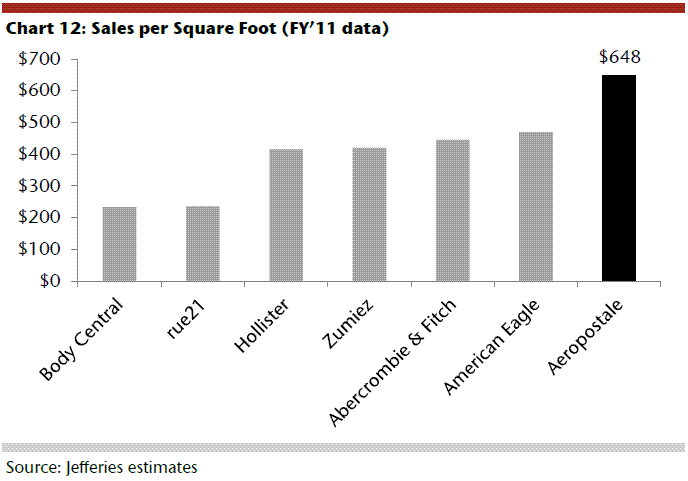
Aeropostale has some of the most productive stores in the specialty retail space. While the sales per square foot metric will be down this year vs. LY, we believe this very high level of productivity shows that the stores are in a cyclical slump, not a secular one.


Aeropostale currently has 5.2m fans on its Facebook page

Sentiment is Already Very Negative. ARO has significantly reduced its earnings outlook this year and the stock is down over 50% YTD (vs. S&P down 5%). Further, sentiment is very negative with short interest near 20% of the float and very few buy ratings on the stock.

Back in early 2009, investor sentiment around ANF was particularly negative. This is illustrated by the high short interest and low number buy ratings among sell side analysts. ANF’s short interest as a percentage of the float peaked at ~19% in April 2009 as investors viewed the brand as largely dead and the company’s long term story broken. Analyst sentiment was also quite negative for ANF with less than 30% buy ratings, ~60% hold ratings and over 10% sell ratings.


What We Expect Will Happen at ARO
Investor sentiment around ARO has become increasingly negative this year following multiple downward earnings revisions and slowing fundamentals. We believe many investors view the ARO story as broken (much like they did for ANF in 2009).

This is evidenced by ARO’s short interest as a percentage of the float which has been increasing and is currently at 16%. Analyst sentiment is also negative for ARO with only 20% buy ratings, over 60% hold ratings and almost 15% sell ratings.

Among our coverage universe, ARO’s buy ratio (defined as the number of buy ratings as a percentage of total ratings) is one of the lowest at 21%. This compares to the average Buy ratio among our group of over 50%.


Risk/Reward Now Compelling to the Upside. With the stock one of the worst performing in our coverage universe, we now see little downside risk and meaningful upside in the coming months as margins and top line begin to recover. As such, we view risk/reward as very attractive at current levels.


Notablecalls: I'm calling this one Actionable Call Alert.

Here are my reasons:

1) Konik has done a very good job in ARO. He cut the name to Underperform on Jan 3 when the stock was trading around $25. Straight down. He kept pounding it all the way, ending with a $12 price target in August.

He upgraded ARO to a Hold on August 16 saying ARO had played out to his thesis with significant top-line and margin erosion YTD.

2) Konik compares ARO to ANF in 2009. A wild ride. But he was right. So right.

3) The call reads well and short interest stands at 18% of float. Sentiment is uber-negative so it won't take much to light up the stock.


I don't see this thing stopping before it hits $13 in the n-t. I suggest you don't chase it too high in the pre market and watch for any pullbacks after open to buy.

Longer term? A potential double or more.

(PS: Posting this around open)

Wednesday, October 05, 2011

Notable Calls Network (NCN): AM, SFLY & CSCO

We have caught some interesting (and profitable!) situations at Notable Calls Network (NCN) in the past couple of days:


1) Shutterfly (NASDAQ:SFLY), American Greeting (NYSE:AM)

Apple announced yesterday at their iPhone 4GS event that they will be releasing an app for iOS devices, where users can create and mail 1 to 1 greeting cards.

- Around 1:28 PM ET a particularly sharp & knowledgeable NCN member hit me with the following remarks:

New iPhone, iPad app called "Cards" allows you to make cards to send to people. American Greetings (NYSE:AM) getting hit on this, Shutterfly (NASDAQ:SFLY) also. "SFLY might get killed on this, " he added.

I quickly blasted the comments to NCN. Here what's happened:


American Greetings (NYSE:AM) went from $18 to as low as $16 (2 pts)

Shutterfly (NASDAQ:SFLY) went from $39 to as low as $33.50 (5.5 pts)

Both trades had ample size to be taken.

- We also caught a couple of analyst defends in SFLY, as around 1:55 PM ET Morgan Keegan was out defense of the name saying Apple has been in the photo market for years with iLife and its latest app does not appear to challenge Shutterfly in events and occasions, design choice, or even on price. (Marked green on the chart)

As you can see that also delivered for us.


2) Cisco Systems (NASDAQ:CSCO)

- Around 10:33 AM ET a hedge fund manager primaly focused on technology sector pinged me with the following snippet:

WASHINGTON (Dow Jones)--A bipartisan pair of senators plans to introduce on Thursday a bill proposing a tax break for U.S. companies that bring home foreign profits.

"= CSCO, MSFT, AAPL," he added.

This made perfect sense. Cisco (NASDAQ:CSCO) buybacks! Offshore cash!

- Here's what happened: $0.50 move in CSCO.


Later a NCN member told me he got $0.20 on 150,000 shares from the call. That's $30,000 profit in one trade.

These are the things that make me smile.


This is how Notable Calls Network (NCN) works - sharing the flow. We catch them every day.

Want to be part of NCN?

It's easy. Just shoot me a brief email that includes a short description of yourself and your AOL nickname.

Please do note that contacts via IM are limited to people with:

- 3+ years of trading experience

- Access to quality research/analyst commentary

- Ability to generate and share (intraday) trading calls

I will not accept contacts from purely technically oriented traders, penny stock fans or people who have less than 3 years of experience in the field.

Monday, October 03, 2011

Priceline.com (NASDAQ:PCLN): Upgrade to Overweight at Morgan Stanley

Morgan Stanley's Internet team is taking a bold step and upgrading Priceline.com (NASDAQ:PCLN) to Overweight from Equal-Weight while establishing $650 price target.

Firm believes the market is incorrectly assuming that Booking.com has limited growth potential in Europe and APAC due to escalating competition and macro weakness, providing investors with a compelling buying opportunity. Morgan Stanley is raising their estimates above consensus.

The details (in short):

European competitive advantage + secular tailwinds outweigh cyclical risk: Based on our checks, Booking.com still provides the best value proposition to European hotels with the lowest commission rates and largest customer reach relative to competition. Additionally, Booking.com is well positioned to benefit from the ongoing offline-to-online shift in European hotel bookings, which in our mind, outweighs cyclical risk. We model Booking.com increasing its share of the European hotel market from ~8% in 2010 to ~18% in 2015.


Asia Pacific: a new opportunity: Booking.com brings a unique value proposition to Asian hotels with its large European customer base, which local online travel agencies are unable to provide. Additionally, the recent appointment of Darren Huston as CEO of Booking.com (former CEO of MSFT Japan) brings valuable knowledge on effective APAC marketing strategies. We are not modeling Priceline dominating the APAC market, but rather continuing its current growth trajectory, growing market share from ~1% in 2010 to ~5% in 2015.

Valuation: At current price levels, Priceline trades at 11.5x 2012e EV / EBITDA, a discount to Ctrip at 15x and Make My Trip at 30x. We believe Priceline’s multiple will expand closer to its Asian counterparts, as Booking.com gains market share in Europe and Asia Pacific

Notablecalls: Big mo-mo names have been under pressure past days, possibly because of JAT liquidations. As one of the top guys on Notable Calls Network (NCN) notes PCLN has fallen too much too fast and is now getting a size upgrade & target.

PCLN is squeeze material. The market needs to cooperate of course.

Same goes for Netflix (NASDAQ:NFLX) which is getting +ve Research Tactical Idea (RTI) from Morgan Stanley.

"The TRIN closed at 3.89 which is a bit panicky, I think we can get a down to up on the day at some point", another trader notes.

Wednesday, September 28, 2011

Netflix (NASDAQ:NFLX): Subscriber Churn Stabilizing - Piper Jaffray

Piper Jaffray is out with some interesting comments on Netflix (NASDAQ:NFLX) this morning noting their 2nd Subscriber Survey shows churn stabilizing in late Sept.

- As a follow-up to their 350 subscriber survey in mid-August, they firm recently surveyed 250 Netflix subs to gauge subscriber behavior. The outcome of the survey, conducted on 9/19 (after the apology email from CEO Reed Hastings to subscribers announcing the Qwikster spin-off), was similar to the mid-Aug survey; however, the number of subs that expect to quit the service is now down to 10% from 15% previously.Piper believes their survey shows that subscriber cancellations are stabilizing after being higher than expected for the majority of Q3. While they continue to expect elevated churn over the next few quarters, the risk of a mass exodus appears to be moderating following their mid-Sept. survey.

Firm reiterates Overweight & $300 PT.

Here's the gist of it:


Couple of points:

1) People planning to quit Netflix is down to 10%.

2) People planning to move to Redbox is down from 56% to 42%.


NO MASS EXODUS.

Notablecalls: Why this is important? I hate to say it but if you look at Olson's mid-August survey closely enough, you will know why. The survey rather cleraly highlighted people's discontent towards the price hikes. It showed people planning to leave NFLX and join CSTR.

I remember arguing about it with a guy sitting next to me at the desk. We both knew the info was material but we didn't have the guts to go against the tape and short the name. What happened was NFLX went down and CSTR went up big. We looked (and felt!) like two putzes. That was August 17 and NFLX was trading around $240+.

Now we have the stock down $100+ pts and Olsen is saying monthly churn won't be as bad as the initial read suggested.

Will it be enough to produce a bounce in NFLX?

I don't know. The chart looks bad & AMZN is about to reveal their streaming service today @ 10:00 AM ET.

Gotta play this one by ear today. Could see $10+ upside, if people really pick it up.

Monday, September 26, 2011

Netflix (NASDAQ:NFLX): Upgrade to Buy at Merriman

Merriman's Eric Wold is upgrading his rating on Netflix (NASDAQ:NFLX) to Buy from Hold with a $155-175 valuation range.

The analyst notes they downgraded NFLX to Neutral on July 6, the shares have dropped 55% vs. a 15% decline in the S&P 500. At this point, they believe their near-term concerns are more than reflected in the valuation - which no longer gives Netflix credit for its industry positioning and long-term potential. Firm is upgrading NFLX to Buy in spite of the near-term headwinds as their downside 2012 EPS analysis still shows solid growth potential over 2011. They are making no changes to their estimates at this time and see upside to $155-175 using a P/E of 25-28x.

The details (in short):

Downside 2012 EPS scenario still shows growth. In our downside analysis for 2012, we come up with a potential range of $4.49-5.95. The midpoint of $5.22 still represents a solid 21% growth over our current 2011 EPS estimate of $4.33. Given the consensus range of $5.38-9.69, we believe it is apparent that there are numerous drivers that could push results either way. However, we believe our analysis shows a realistic downside scenario that should give investors comfort in Netflix's still strong industry position - and that 2012 solely represents a potential pause before strong margin/EPS growth resumes in 2013.

Starz savings could offset earnings pressures. During 2012 we see three main earnings headwinds that could potentially push EPS below current expectations: 1) migration of DVD-only subscribers; 2) international launch operating losses; and 3) competition causing upward pressure on SAC. However, we believe the $250M in 2012 content savings from the Starz cancellation gives management some wiggle room should they not find
alternative content (or choose not to spend the surplus).

Two biggest drivers firmly in control. At this point, we believe it is increasingly clear that the two biggest earnings drivers in 2012 - marketing and content spend - are firmly in management's control. This is key in that should spending on those two areas not generate positive results, we believe management could easily pull back the reins to maintain solid profitability by catering to existing subscribers instead of pushing to add new ones.

Division split more of a content decision. We understand some believe management's decision to split the streaming and DVD divisions is to better position the streaming division for a sale to a larger competitor. However, even though this may help to improve the sum-of-the-parts valuation multiples afforded by investors, we believe the larger driver was to aid in content negotiations with a smaller number of streaming subscribers driving cost discussions (i.e., lowering the cost) vs. the entire pie (including DVD-only subscribers).

Near-term risks remain in spite of upgrade. Our decision to upgrade to Buy from Neutral today is not based on any improving outlook for the near-term and continue to see risk in subscriber trends through yearend. Furthermore, based on our EPS analysis, we believe there is a morethan- likely chance that 2012 consensus estimates (and possibly our belowconsensus estimate) may need to be reduced. Nevertheless, we believe NFLX shares already more than reflect these risks and should our downside analysis prove aggressive, we could see the shares rebound sharply in 2012 on an improved growth/margin outlook.

Notablecalls: Eric Wold nailed it on July 6th when he downgraded NFLX to a Hold from Buy saying the co would be entering a period of restrained operating margins.

He played the name so well on the way up and looks like he played it even better on the way down. Some of this performance can surely be attributed to blind luck (at least ONE of the analysts among many should get it right) but I do like his style. As was the case with the downgrade, Wold is not being pushy but rather pointing out things may not be as bad as the market suggests. According to Wold, 2012 may bring a sharp bounce-back.

Another thing that caught my eye this morning is that the analyst community is not overly excited about the DISH movie streaming package. It appears to cost more and have way less content that the NFLX offering. So n-t overhang lifted there.

(Now we can all go on and start worrying about what AMZN will unveil in 2 days).

Anyway, I wouldn't be surprised to see the stock lift following the Merriman upgrade. Hopefully another brilliant call for Eric Wold.

Give Kudos when it's due. I do!

Wednesday, September 21, 2011

Autodesk (NASDAQ:ADSK): Actionable Call Alert!

J.P. Morgan's Software team is flip-flopping some names under their coverage this morning:

- ADSK, ROVI get upgraded to Overweight while VRSN and DOX are cut to Neutral.

I want to focus on Autodesk (NASDAQ:ADSK). JPM is upgrading the name to Overweight from Neutral with a $40 price target.

According to the firm, ADSK is one of the best franchises in their coverage. It has a substantial market share in a couple of key industry segments (AEC and Infrastructure) and is very competitive in manufacturing design software. The business is highly cyclical and they missed two other good entry points during the downturn in February of 2009 and July of 2010. They believe investors should take advantage of the cyclical pullbacks to build positions in what they consider a high quality software franchise. In addition, this next cycle has the potential added benefit of a move into product suites, a strategy that has helped companies like Adobe breathe large new growth opportunities into its business and something they think could underpin at least a 12% top line CAGR for ADSK over the next five years.


The details (in short):

Move to suites should provide at least 12% CAGR over 5 year horizon
Over the years we have watched a couple of software companies move from offering just point products to bundles of products to ultimately product suites that tightly integrate solutions and at attractive combined pricing. The first most notable company to follow this strategy is Microsoft with the Office suite, but we believe the best comparison for Autodesk is Adobe and its move to suites.

We went back and looked at the penetration rates of suites for Adobe and the impact on revenue and applied this to Autodesk. Result is that we see a base of 12% revenue CAGR over the next five years. Reason we say a base is that we lack perfect insight into the user base at Autodesk for products like Revit where we think there is potential to add another 3-4% to the revenue growth. But we think this view of Autodesk suite opportunity is very interesting given it is based on another software company with a very loyal customer base in Adobe.

Recent market action sets a range in our mind where the stock we think offers $12 of upside if the economy improves against the risk of $4-5 of downside if the economy worsens.

Notablecalls: JPM picked a (very) good day to upgrade ADSK as the August Architectural Billings Index (ABI) published last night showed a surprising jump.

The Architectural Billings Index (ABI) is a survey by the American Institute of Architects (AIA) and is viewed as a leading indicator of nonresidential construction activity. A score of 50 or above indicates an increase in billings. The AIA believes the index has a correlation with nonresidential construction spending 9-12 months into the future.

ADSK is one of the leading providers of software used by architects and engineers. If AutoCAD means anything to you, you're on the right tracks.

In a bit of a shocker, the ABI spiked higher in Aug. The index jumped 6.3 pts from 45.1 to 51.4. That's the biggest m/m change in 5 years (Aug '06). "Based on the poor economic conditions over the last several months, this turnaround in demand for design services is a surprise," said AIA Chief Economist, Kermit Baker, PhD, Hon. AIA. "Many firms are still struggling, and continue to report that clients are having difficulty getting financing for viable projects, but it's possible we've reached the bottom of the down cycle."

Here's an illustration from Morgan Stanley explaining why ADSK shareholders track the ABI index:

So there you have it. JPM upgrade and an explosive move in the ABI index should get ADSK moving. The stock should trade towards $30 level in the n-t, possibly surpassing it if the tape holds.

Let's see how it goes. I'm going to call this one Actionable Call Alert!

(PS: I'm posting this right around open)

Monday, September 19, 2011

Mckesson (NYSE:MCK): Rapid Profit Expansion Expected Near Term; Upgrading Cardinal and McKesson to BUY - Citigroup

Citigroup's Health Care Distribution & Technology is making a fairly big call upgrading both Mckesson (NYSE:MCK) and Cardinal Health (NYSE:CAH) to Buy from Hold.

- Mckesson is added to Citi's Top Picks Live (TPL) list with a $101 price target (up from $90).

New Generic Introductions Should Provide Outsized Profits in C2012 – In the report, Citi examines the upcoming branded to generics wave set to impact the drug distributors beginning in 2011 though the end of 2015. They look at 100+ drugs that currently generate about $90 billion in revenue and their impact on wholesaler profits and margins. Firm estimates that the branded to generic conversion wave will lead to outsized profits and sustainable higher margins for the wholesalers.

The details:

Industry Top Lines Should Begin to Shrink in C2012 – One dynamic of the branded to generic drug conversion cycle is that wholesaler top lines should begin to decrease in 2012. Single source generic drugs can sell at about half the reference drug price and we believe many large customers will buy these generics direct, leading to significant leakage out of the wholesaling channel. We estimate that wholesaler revenue levels could shrink 2% to 8% in the 2012/2013 time period on a reported basis and 5% to 10% on a like for like basis, excluding acquisitions and nondrug distribution businesses.

But Gross Profits Should Expand on Mix – Within the customer base that buys generics from the wholesalers, generic drugs can be 3x to 20x as profitable as their branded drug counterparts. This should lead to both absolute higher profit levels and higher margins for the wholesalers reflecting the shifting mix to generics as a higher percentage of total drugs sold. About 50% of generic drugs dispensed in the U.S. are bought by retailers (or mail order) directly from the manufacturer, meaning the wholesalers will share the generic profit opportunity with other parts of the channel.

Difficult Comparisons Begin in 2H-2013 – We believe an underappreciated dynamic of the branded to generic conversion is the level of profits contributed by single or dual source generics, compared to multisource generics. These limited source generics can produce dollar profit levels that are 3-4x the multisource equivalent. So as many of these drugs move through their life cycles to multisource competition, the gross profit contribution from these drugs will decrease substantially. This should create difficult comparisons in 2013, as drugs including Lipitor, Lexapro, Seroquel, Plavix and Singular should all see multisource generic competition.

Upgrading Cardinal Health and McKesson to Buy, Maintain Hold on AmerisourceBergen – Our revisions make us at or near the Street High estimates on both companies for their F2012 and F2013, implying significant positive revisions which should lead to multiple expansion from current levels. Our target price on CAH goes to $51 from $44 and our target price on MCK is now $101 from $90.

Notablecalls: My poison of choice here would be MCK, as the name is added to the TPL with a very nice $101 price target.

What really makes the call interesting are the catalysts:

- Lipitor is going to launch in Nov 2011, that's 45 days from here. It's the largest drug in the world by sales which should create some excitement among investors.

- McKesson benefits when UNH brings PBM business in house. Of course that won't happen til 2013.

It's a 54 pg. note so the good people at Citi have put work into the subject. The sales will be making a lot of calls today pushing MCK & CAH to clients. Especially MCK since it was added to the Top Picks Live list. Nice defensive name too.

I expect a nice up day for MCK. $78+?

(Posting this after open)

Thursday, September 15, 2011

Central European Distribution (NASDAQ:CEDC): Merger Talks with Anisimov, Rosspirtprom? - Citi

Citigroup's Beverages team is out with some interesting comments on Central European Distribution (NASDAQ:CEDC) noting Russian newspaper Kommersant has a front-page article this morning saying that CEDC is in merger talks with Vasiliy Anisimov and Rosspirtprom to combine their respective Russian assets into a single organisation.

According to the article, the discussion is around Anisimov receiving a 20% stake in CEDC in exchange for his various Russian alcohol assets (86% of Moscow vodka factory Kristal, VEDK distribution business with the exclusive distribution contract on the popular brand “Putinka”). A third party in the deal is reportedly Rosspirtprom, under whose umbrella the combined Russian assets would be managed. According to data in Kommersant, this would potentially increase CEDC’s market share from 14% to ~21%. None of the parties involved have commented on the press report.

According to Citi, this is not the first public speculation over a deal for CEDC and may not be the last given the difficult position the company finds itself in due to a combination of an underperforming operational business and a stretched balance sheet. Previously the stock has reacted positively to press speculation of acquisition (press reports of a $17/share offer by Roman Abramovich in May that an Abramovich spokesman later denied) or to investors building a large stake (Mark Kaufmann issued an SEC filing recently saying he had acquired 9.6% of the company). Last week CEDC’s Board of Directors adopted a “poison pill” giving them power to significantly dilute any potential unfriendly buyer, which could be taken as a sign the BoD has other plans for regaining investor confidence.

While it would be too early to make a fundamental analysis based on the details available, Citi's initial impression is that if such a deal is under consideration, they see more positives than negatives.

– First, this may solve CEDC’s Russian performance issues through the return of key managers who built the core Russian Alcohol Group (RAG) which CEDC acquired in 2008 (but who now, according to Kommersant, work for VEDK and Rosspirtprom). While they do not know the two managers in question they believe this change would be taken positively by the market considering the visible success of initially building the RAG business (and subsequent decline once these managers left).

– Second, the combination of improved consolidated cash flows and the return of these key managers would in our view significantly improve the company’s chances of meeting a major re-financing challenge in March 2013 when $300mln in convertible bonds comes due.

Notablecalls: CEDC has been beaten to bits following 3 disappointing quarters and I suspect that any change in leadership and operations will be welcomed by investors.

Rememeber, this was a $26 stock mere 8 months ago.

Gaining 28% market share in the Russian Vodka market? That's fairly significant. #1 player.

CEDC produced a 50%+ move on August 29 following the Kaufmann stake news which means it's a mover.

I'm guessing CEDC will see $7.50-8.00+ on this.

Here's the Kommersant piece, use Google translate.

Monday, September 12, 2011

Notable Calls on Twitter

Gentlemen,

I'm going to have another go with this Twitter thing. It didn't feel right the first time around but let's see how it works out this time. Just to give a little taste of what's going on at the Notable Calls Network (NCN) intraday.

http://twitter.com/#!/thenotablecalls


Good luck,

NC

Tuesday, September 06, 2011

SodaStream International (NASDAQ:SODA): Upgrading To OW As Valuation Has Gone Flat - JPM

J.P. Morgan is upgrading SodaStream International (NASDAQ:SODA) to Overweight from Neutral with a $50 price target (prev. NA).

With the company reporting roughly in-line Q211 earnings and disappointing full year guidance, the stock has taken a major hit, dropping about 48% while the S&P has been up nearly 5% over that same time frame. While the stock has obviously lost momentum, they continue to believe that the short to medium term growth potential for SODA is strong and that their 2H guidance will prove to be too conservative. With the multiple having compressed from roughly 40x down to about 19x, 17x ex-cash, and with guidance that seems overly conservative, the firm thinks the stock is attractive here.

The details:

Growth is still there despite the conservative guidance. Even though SODA simply reiterated their FY11 guidance, which alarmed a number of investors, we continue to believe that SODA is a growth story. We believe the company’s 2H11 guidance is far too conservative as the company implied top line growth of nearly 31% for Q311, but only 10% growth YOY in Q4. Even though SODA faces a tough +59% comp in Q411, we note that their total US door count at this point (assuming no move into mass) has grown by +86%. In the end, we think that SODA's guidance will prove to be too conservative and we expect the test in mass (and a potential full roll-out) to provide upside to Q4 numbers. We are currently forecasting 16% revenue growth for Q4, but think our estimate could be too low.

At 19x our FY12 estimate, 17x after adjusting for cash, the stock is too cheap. With the stock down more than 50% from its high, we believe that stock is clearly much more attractive, especially as we believe there are no material changes to the story. With the rest of our group having re-rated positively since the market’s turn, SODA is just trading at a slight premium to the group.

US door growth is high, and trends continue to be strong at BBBY. We expect US doors to be up almost 100% yoy in Q4, and while the comps get more difficult, we still expect strong growth. Over the past few weeks we have contacted a number of Bed, Bath, and Beyond locations (BBBY locations are about 13% of US doors) to get an update on SodaStream products. Overall, it appears that machine and flavor sales, along with C02 refills continue to be strong, which is very encouraging.

We rate SODA OW. While the LT growth profile is less than the bulls would like to think, the ST results should be better than expected. Establishing a $50 price target for December 2012 based on 21x our 2013 estimate. As management discusses the conservatism baked into their Q4 guidance, we expect the multiple to move up

Notablecalls: SODA was a $80 stock back in the beginning of August. The recent high-flyer got smashed after management failed to raise guidance on its most recent conference call.

So now it's at $35 trading 19x EPS while growing EPS by 30%+. We saw a couple of tier-2 firms pound the table to bits on the way down, with little success.

Now we have a tier-1 firm out saying SODA is not a broken story and that things are going pretty well for them. JPM actually highlights some checks they made and these came back positive.

That carries some more weight. A lot more weight actually. Short interest stands at over 70%. The valuation is bound to adjust at some point.

One to watch. If this one gets going, the shorts will have one hell of a task keeping it down here.

Tape's drek but the lower we open the better chances we have for an outsized bounce in my humble opinion.

Friday, September 02, 2011

OmniVision (NASDAQ:OVTI): Post F1Q earnings sell-off overdone - JPM

J.P. Morgan's Paul Coster had a chance to touch base with OmniVision's (NASDAQ:OVTI) CFO, following his return from Asia Pacific region.

- The feedback?

Surprisingly positive.

Coster says he is now convinced that weaker-than-expected F2Q guidance originated in industry-wide weakness in the CE supply chain and does not originate in a head-to-head competitive loss at a Tier 1 OEM. For this reason, he thinks the post F1Q earnings sell-off overdone & recommends buying the OW-rated name.

The details:

Re-visiting F2Q Guidance. The CFO’s commentary is consistent with the earnings call. The weaker-than-expected (by sell-side analysts) F2Q guidance originates in several concerns: 1) slowing PC/Notebook sales, 2) component channel inventory build-up, 3) temporarily weak demand from some OEMs that are experiencing “transitions” (possibly RIM, Nokia), and 4) the later than expected ramp in BSI-2 product.

Head to head with Sony. OVTI’s CFO appeared unsurprised by Sony's August 30th CIS presentation and acknowledges that Sony is a credible competitor at 8MPx. That said, he believes OVTI has only gone head-tohead with Sony once (so far) and claims that OVTI won the resulting design opportunity for a 2012 product.

What about Apple iPhone 5? Consistent with past practice, the CFO will not acknowledge Apple as a customer, whether direct or indirect. That said, the CFO made the point that build lead-time for handset OEMs has collapsed to 30 days (from chip shipment to finished product in retail), and can be crammed down to 15 days under duress. We think this lead-time is surprisingly short, and is consistent with OVTI being well-positioned for the holiday ramp with Tier 1 OEMs (including Apple), notwithstanding the disappointing F2Q guidance. It is, for
instance, consistent with the notion that OVTI introduces BSI-2 8MPx product in late F2Q, and still captures Apple iPhone 5 opportunity if that product ships in mid/late October

What is the problem with BSI-2? The CFO denies that there are design issues with the BSI-2 chip, but acknowledges that the manufacturing process has not yet met the company's expectations regarding consistency. We view this as an engineering challenge that can be resolved in the next month or so.

Notablecalls: OVTI got clobbered a week ago following #'s. The reasons? There were 3:

- The conference call was just awful. I hope OVTI's management is reading this post. Guys, stop beating around the bush and get to the point. I had to read the transcript 3x and I still had hard time understanding what the heck was said.

- Concerns around Apple. It appears this call by Coster does a fairly good job putting some of these in bed. OVTI's CFO is hinting they still have the AAPL deal (we know AAPL & Sony went head-to-head on this).

- BSI-2. That's an issue. I'm not entirely sure TSCM can get this right in the next month or so. (Kudos to FBR on this! Brilliant call!)


All in all, I suspect OVTI may produce a bounce here following the JPM comments. Back above $18?

Tough call to make in this tape, obviously. Why not just buy the effin' market.

PS: I'm posting this after open.