Monday, September 27, 2010

Wynn Resorts (NASDAQ:WYNN): Expect Continued Market Share Losses in Near Term at Wynn Macau - Barcap

Barclays is making some fairly cautious comments on Wynn Resorts (NASDAQ:WYNN) saying they expect continued market share losses at Wynn Macau. Firm is lowering estimates and price target.

Given their expectation for continued market share losses in the near term at Wynn Macau, Barclays is lowering their revenue and EBITDA estimates at the property. During firm's trip to Macau last week, many market participants remarked that several operators, including MGM, were attracting junkets from Wynn Macau.

Wynn has typically paid at or below market commissions in Macau; in recent months, the company has paid 40% of win compared to approximately 45% to 46% of win for the market. Wynn has typically been able to compete for junket VIP business through its luxury product and superior service while paying at or below market commissions.

Barclays is lowering their revenue and EBITDA estimates for the property. Wynn has typically paid at or below market commissions in Macau, instead competing for junket VIP business through its luxury product and superior service. However, as junket operators take advantage of an opportunistic commission environment, some are diversifying business away from Wynn. Wynn’s VIP market share has fallen in recent months, and the firm believes it could fall further in 4Q10.

They believe both player and junket demand for Wynn Macau’s luxury hotel product and premium service should mitigate or reverse these trends in the long term; however, in the short run, volatility in VIP volumes could result in lower results than previously expected.

Barcap's new 3Q10, 2010 and 2011 EBITDA estimates for Wynn Macau are $182.3 million (down from $189.9 million), $758.4 million (down from $782.6 million) and $773.8 million (down from $850 million).

Their Wynn Resorts 2010 EBITDA and EPS estimates go to $963.7 million and $1.44 from $987.8 million and $1.61, while 2011 EBITDA and EPS estimates decline to $1,009.4 million and $1.94 from $1,085.5 million and $2.42. Barcap's price target goes to $84 from $92. Maintains Equal Weight rating on the stock.

Notablecalls: When was the last time you saw an actual estimate cut on WYNN? I sure cannot remember one in recent history. Barcap is saying Macau is starting to see increased competition, which is going to eat into WYNN's margins.

I think this serves as a surprise to many. Stock should see some downside. Hard to quantify but maybe around 2-3 pts. I know WYNN is a cult stock, so be sure to adjust your risk accordingly.

Infinera (NASDAQ:INFN): Downgrade to Sell, expect a miss n-t - Goldman Sachs

Goldman Sachs is making a significant negative call on Infinera (NASDAQ:INFN) downgrading the name to Sell from Neutral with a $8.50 price target (prev. $7.50).

Firm notes they downgrade INFN to Sell from Neutral following the stock’s 100% rally over the last three months on a combination of risk to estimates and full valuation. While the market appears to be pricing in robust growth going forward, they see Infinera’s opportunity as more limited over the next 12-18 months as a result of: 1) the market’s transition from 10G to 40G, where Infinera doesn’t have a native solution; 2) intensifying pricing pressure in 10G; 3) peak gross margins in 3Q2010; and 4) a possible inventory correction at customers. They also view valuation as full at a CY2011 EV/S of 2.1X, vs the CIEN/TLAB/JDSU average of 1.1X. Goldman's $8.50 price target implies 34% downside potential.

Catalyst
Goldman expects Infinera’s results to disappoint over the next few quarters, with their CY2011 sales/EPS estimates 13%/66% below consensus due to the significant operating leverage in the model. While they believe the market extrapolated the recent quarter’s strength to next year’s estimates, the firm expects sales to moderate or even decline over the near term, as supply chain shortages get alleviated and as Infinera will likely lose share in the 40G transition. Longer-term, that strength appears unsustainable, as Infinera’s pace of new customer additions has declined to three per quarter in 2010 from five per quarter in 2007, and its peak margins suggest that its mix of business is heavily skewed to line cards (i.e., shipments to existing customers) rather than the more forward-looking common equipment (i.e., new footprint buildouts).

Goldman sees meaningful risk to Street estimates with their CY2011 sales estimate of $477 mn – 13% below the Street at $545 mn – due to several factors described in more detail in the note, and EPS is 66% below consensus due to Infinera’s significant operating leverage given its vertically integrated business model. THey believe the Street erroneously extrapolated Infinera’s recent strength – with 2Q sales up 16% qoq – into the future, interpreting it as a reflection of strong secular growth opportunities. In contrast, the firm believes the optical networking market remains challenging, with enormous pricing pressure offsetting strong volume shipments to drive only single-digit revenue growth. They believe the recent strength in Infinera’s business may have been due to its customers’ attempts to alleviate supply constraints, as its new customer additions decreased to an all-time low. This could set Infinera up for a pullback, similar to that recently experienced by component vendors PMC-Sierra and Exar, when its customers’ inventories catch up with demand. In addition, we view the transition from 10G to 40G currently underway as a negative for Infinera, given its recent decision to skip from 10G to 100G in its proprietary product roadmap, and to address the 40G node with a merchant solution. Lastly, they expect Infinera’s gross margins to reach their historical peak levels this quarter, which could limit operating leverage going forward, signifying a mix of business that is more driven by line cards (i.e., harvesting prior design wins) than chassis (i.e., building new footprint).


Lastly in terms of set-up, Goldman notes the significant decrease in short interest over the last few months following Infinera’s strong 2Q results. Given the stock’s 100% move over the last three months and significant short covering, they don’t believe their below- Consensus estimates are reflected in the current stock price.

Notablecalls: The call reads badly. Goldman sees multiple headwinds ahead while the stock is sporting a fairly high valuation. The high valuation is due to current tech environment where every small player with a technological edge seems to be in play.

But hey, didn't Goldman just say INFN doesn't have much of a tech edge? Infinera’s 100G solution is late to market, behind CSCO, ALU, Huawei etc.

Goldman is also calling for a miss over the next few quarters, which is usually bad news for a co that trades 30x EPS.

Anyway, I think INFN will trade down today. Not going to get crushed, though.

Trades towards $12 or possibly below (in case the general tape exhibits some weakness).


PS: (update 8:49AM ET) Pacific Crest is raising their tgt on INFN to 20 frm 12. So careful shorting this one.

Thursday, September 23, 2010

Edward Lifesciences (NYSE:EW): Expect sell-the-news reaction

So far, so good with the s-t bear thesis. Altera (ALTR) worked out nicely yesterday. With the market looking down this morning, I'm on the hunt for additional short-selling candidates.

Today I'm looking at Edward Lifesciences (NYSE:EW). I gave a lengthy review on the co back in June.

Wednesday after the close the long-awaited results of Edward’s PARTNER Cohort B trial were published in the New England Journal of Medicine. The SAPIEN was a success, at least on the surface.

- JP Morgan's Michael Weinstein, who rates EW at Underweight is out with some interesting comments:

First, we believe that the Cohort B results should support US approval of Sapien for use in inoperable patients. While there were certainly some issues raised by the data , the trial met both of its endpoints by a wide margin. Patients treated with Sapien experienced 30.7% mortality at 12 months compared to 49.7% for those treated medically (p<0.001), style="font-weight: bold;">In the meantime, Edwards’s valuation already assumes significant success for Sapien once it does launch domestically. If we apply the current NTM P/E multiple for the large-cap group (11.5x) to the company’s base business, it implies a valuation of $23.71 per share. Assuming that the stock opens today around $65, that leaves more than $41 per share, or nearly $4.9B, in value attributed to Edwards’s transcatheter valve program. Using an 11% discount rate, we estimate that peak sales would have to exceed $2.2B to justify that valuation, with EBIT approaching $1.0B. Our own model calls for peak sales of roughly $1.7B with EBIT of $750M. It’s also worth noting that for Sapien to get to $2.2B and, more importantly, to sustain that level, the TAVI market would most likely need to reach $4.5B in size, as rarely in cardiovascular devices does one company end up controlling more than 50% of a market. To put that in perspective, the worldwide drug-eluting stent market is expected to be roughly $4.3B in 2010, and the entire surgical valve market (including repair) will likely approach $1.5B.

That said, there were plenty of issues with the trial, some of which are likely to dictate FDA labeling and training requirements:

- More concerning is the strikingly poor randomization of patients within the trial.

- Finally, treatment with Sapien was associated with some serious adverse
events.

What does it mean for the stock? As we noted in our preview, the chances of a negative trial outcome were remote given the significant structural changes to the study design over the past two years and inclusion of the co-primary endpoint, which we viewed as an easy target. However, there was legitimate uncertainty about whether Sapien could demonstrate a mortality advantage in this very sick patient population, without which the issue of approvability could have been thrown into question. With this risk now removed, we would expect EW shares to trade up ~10% on Thursday to the mid-60s, though whether it holds that level is another question, as we fully expect to see some profit-taking.

An FDA panel for the Cohort B indication is in all likelihood a minimum of eight months away, with final approval following a few months after. Meanwhile, follow-up in Cohort A should be completed soon, but presentation of the data will likely wait until the ACC conference in March.


- This is what BMO has to say about EW this morning:

We expect the stock to be up meaningfully given the results,and we would not be averse to investors trimming positions and taking some profit off the table. Our MARKET PERFORM stock rating is predicated on EW’s valuation as we think the stock is ahead of itself. From a longer-term perspective,the only thing that keeps us on the sidelines is valuation.

- Lazard has the following comments:

We note that the control arm was statistically (p=.04) sicker, with a logistic EuroSCORE of 30.4% vs. 26.4% in the Sapien arm. While mortality may have hit the significant threshold in equal groups, from the data it is impossible to tell since the control group was statistically sicker.

We expect this will cause investor debate and maybe a pullback from the $7 increase after hours. It is also likely to cause FDA discussion although we strongly believe that the device will be approved and the statistical mortality benefit will carry physician view and lead to standard of care as the group differences are forgotten.

Notablecalls: I think EW could see a sell-the news reaction today. Note that the NEJM article was originally sent to select docs and journalists already on Tuesday morning (or even Monday evening).

Morgan Stanley was out with a positive Research Tactical Idea on EW on Tuesday morning - the stock shot up 5 pts in reaction to that. It's pretty clear the MSCO guys knew the NEJM data would be positive, although there is no mention of that in the RTI. Anyway, the stock was up 5 pts on 4M shares. Most of this 4M is probably fast money types that will be looking to cash in their chips as soon as today.

JPM, BMO and Lazard are calling for profit taking.

Also note that the data was somewhat hairy (randomization) & that EW is trading at a sky-high valuation.

I think EW is a short here around $67. I would give this one some wiggle room, so start lightly. Average up if you need but keep it small.

Wednesday, September 22, 2010

Altera (NASDAQ:ALTR): Shorting @ Open - here's why

I'm not giving up on my short-term bear thesis yet. I think the market is in for a decent correction which leads me to look at downside plays mostly. Just take a look at what they did to Adobe (NASDAQ:ADBE) after a slight miss in guidance. The stock is down 15% this morning and is being downgraded by at least 4 firms. This should serve as a warning to the mindless buying that has been going on in the tech space recently.

So, today I'm looking at PMC-Sierra (NASDAQ:PMCS), the Communication semi player that warned last night. PMCS lowered its Q3 revenue outlook to $161-$162mn (from $169-$177mn), guided for gross margins at the lower end of its previous range (67.5-68.5%), and for lower opex of $64-65mn (down from $66-$67mn).

- Goldman believes that the shortfall in the quarter was mainly driven by weakness at PMC-Sierra’s OEM customers in Asia, including Huawei and ZTE - which mainly serve the domestic Chinese and overseas emerging markets.

Goldman recalls that on its 2Q earnings call, management noted that there was some inventory that wireline customers in China needed to work down in 3Q before this segment of the business would grow significantly. Their view is that these inventory reductions may have extended to the wireless business as well. On the surface, this seems at odds with Altera’s recent positive pre-announcement, which cited strength at wireless customers in particular. Firm believes that Altera’s strong US infrastructure exposure (and PMC’s relatively weak US exposure) is the primary explanation for the disparity in guidance. As they have written previously, they also expect US specific CapEx to peak in 4Q, and remain cautious on Altera and Xilinx in particular as
they see potential downside to Street estimates in 1H2011.

- On September 17, little known technology shop Wedge Partners was out with a highly cautious note on Altera (NASDAQ:ALTR) saying their checks indicate that Huawei has sufficient wireless component inventories for Q4 and the procurement of components has slowed down currently.

Wedge believes that will affect Altera shipment within the next three or four months. They believe ZTE has the similar problem and will do an inventory adjustment in October.

Firm notes they noticed that the Chinese vendor's 2011 forecast for the base station demand have dropped for the Asia-Pacific region, although Indian demand will be up. They think orders for wireline/ broadband chipsets and automobile chipsets remain strong from Chinese vendors, which account for a small portion of their shipments in China.

Notablecalls: I think the evidence against the PLDs continues to mount. Altera (ALTR) and to some extent Xilinx (XLNX) have been utter teflon stocks. I was really surprised to see ALTR recover from the Wedge Partners comments on Sept 17 (stock went down half a pt initially) and proceed to new highs.

Certainly, if there is an analyst cult stock it's definitely ALTR. PLD's replacing ASIC's is a major theme and the analyst community sure has been riding that one.

Yet, with PMCS now out with a full blown warning, people have to step back and reassess.

Shorting ALTR @ open should work.

Tuesday, September 21, 2010

Whole Foods Market (NASDAQ:WFMI): Weakening Sales and Nosebleed Valuation a Bad Combo; Downgrading to Underperform - CSFB

Credit Suisse is making a big call on Whole Foods Market (NASDAQ:WFMI) downgrading the high end retailer to Underperform from Neutral with a $30 price target (prev. $40).

The downgrades comes as the stock’s risk/reward appears to be heavily skewed to the downside. Whole Foods stock is up 366% from its November 2008 low versus a 43% gain for the S&P 500 over this time period. CSFB attributes much of the stock’s relative outperformance to a recovery in the high-end consumer, the company’s acceptance of its structural issues, and early moves to begin correcting its problems. While management is moving in the right direction (the biggest improvement is opening smaller stores), their channel checks suggest that fundamentals are beginning to deteriorate at this high priced momentum story. Firm now sees risk to the company’s fourth quarter fiscal 2010 and full year fiscal 2011 sales and earnings guidance, and believe the stock will grind lower as investors fully digest this issue.

CSFB believes Whole Food’s comp guidance for Q4’10 (+6.5-7.5%) and fiscal 2011 (+5-7%) is at risk. The company experienced a sharp sales recovery over the past year as the high end consumer recovered (their consumer started to spend again), with comps peaking last quarter at almost 9%. While this improvement is impressive, they believe a deceleration is likely as the company begins to cycle more difficult comparisons and believe the slowdown could be more dramatic than management expects. Firm believes comps are currently running in the 5-6% range and project a 3.5-4% increase in 2011. Their conclusion is based on the following:


- Channel checks suggest sales momentum continues to slow.
Whole Foods indicated on its Q3’10 earnings conference call in early August that its comp growth started to slow as its easy comparisons began to end. CSFB's discussions with numerous vendors and other natural/organic sources suggest that Whole Food’s sales momentum slowed further in August and September.

- Upper income consumer sentiment has started to deteriorate.

- Guidance assumes a ramp in underlying sales momentum.


Gross margins have peaked (and could be at risk). CSFB's channel checks suggest that WFMI’s promotional levels have increased recently (with slowing traffic), the company has not fixed its high-priced image in their view, and the key drivers of recent gains have already played out.

SG&A ramp is a concern. The sharp acceleration in expense growth at WFMI recently may be difficult to adjust if sales slow significantly.

Cutting estimates. Firm cuts their Q4’10 EPS est. to $0.26 from $0.29 (vs. consensus of $0.28) and their fiscal ‘11 est. to $1.53 from $1.60 (vs. $1.61).

Stock’s downside far outweighs the upside. WFMI’s valuation (24x fiscal ‘11 EPS) implies its sales/earnings momentum is sustainable in CSFB'sview. Firm's $30 TP assumes the stock will trade back to a more reasonable growth multiple (19x) once the market digests its weakening fundamentals

Notablecalls: The Credit Suisse's food retailing analyst Edward Kelly & his team are no geniuses - they started WFMI at Neutral in mid-2008 when the stock was trading at $30, watched it decline to $10 in 2009, then back up to $40 and are now slapping an Underperform on it. They missed the entire $10 -> $40 move. That's 400% in missed performance. During the 2+ years they have added zero value for their clients.

Today's call is CSFB's first attempt to create some added value. They did their checks & it came back bad. Comps have slowed, gross margin is down due to higher promotions and SG&A is accelerating.

When it comes to retail valuations, Whole Foods (WFMI) trades at a nosebleed level.

The downgrade will hurt WFMI today. I'm guessing to the tune of 5-7%, putting at least $36 level in play.

Monday, September 20, 2010

Temple-Inland (NYSE:TIN): August c'board hike abruptly fails;

While market sentiment seems to be fairly bullish this morning, I choose to look at the potential shorting opportunities. I think the bullish sentiment is currently at or near extremes. That usually indicates we have some downside in store.

Several firms (tier-1's) are commenting on containerboard companies this morning after Pulp & Paper Week (P&PW) reported in its Sept. 17, 2010 issue that some containerboard producers are abandoning the August containerboard price increase in September amidst customer resistance and limited follow through to box prices. As a result, P&PW has rescinded the $40 per ton containerboard increase reflected in August as P&PW believes producers will “rebate the price hike back to customers.”

- Goldman Sachs is out saying the The commentary in P&PW runs contrary to what they have been hearing from containerboard producers over the past few weeks, as well as the tightness in the market reflected in the Aug. containerboard data reported on Sept. 15. Firm had been forecasting containerboard producers to realize an additional $10 of price in September following the $40 increase realized in August.

They are surprised and disappointed by the revision to the August price increase in P&PW given the recent comments and our discussions with industry contacts and with the relatively tight market.

As a result of the lower-than-expected prices reported in P&PW, Goldman sees downside risk totheir 2011/2012 EPS forecasts for containerboard producers, such as Temple-Inland (Buy; last close $20.08), International Paper (Buy; $23.46), and Packaging Corp. (Neutral; $24.35). They expect the containerboard stocks to be negatively impacted on Monday by the price revision, as investors with whom they have spoken recently indicated they were expecting the August price increase to be sustained. However, Goldman does not anticipate significant weakness in the stocks as they estimate the market is already discounting that the August containerboard price increase would not be sustained.

- Credit Suisse - Wham! Last week, the firm notes they learned on Wednesday that US inventories of containerboard ended August at a record low for the month (in terms of weeks of supply). On Thursday, RISI reported that the full €60 per metric ton (about $71 per short ton) price increase in Europe was easily accepted, marking the third price increase in Europe since just April. And then…RISI on Friday night reported that theentire $60/ton US price increase started in August had collapsed, surprising them but probably not the Street (as much) given valuations.

So far in this containerboard pricing up-cycle, there have been two price increases totaling $110/ton (21%), with $50 in January and another $60 in April. These 2 increases have brought US prices up to near "mid-cycle" levels. Amid a global backdrop of tight supplies and limited capacity growth, CSFB sees an additional two increases this up-cycle totaling $80/ton–ironically to just $20 above where prices would have been if the $60/ton August increase had been successful. Moreover, another $80/ton in US prices would mean that US prices are still $52/ton below the current European price!

Lower EPS Estimates, Targets: As a result of their lower containerboard price forecast, they are reducing their 2010, 2011 and 2012 (expected peak year) EPS estimates for the four containerboard-related names (IP, PKG, RKT, and TIN).

- Deutsche Bank has probably the most subdued reaction saying they expect near-term pressure on stocks. Recently, most stocks appeared to be discounting a marked decline in prices - not an increase.

DBAB notes they are not at all shocked that the hike floundered. They're surprised that it occurred in this abrupt fashion. If one assumes that 2011 average prices will now be $40/ton lower, $1.4B in prospective 2011 EBITDA has vaporized. Use a 6-7X multiple on that EBITDA, the hypothetical value implications are impressive. Thishike was a "toughie". But, with operating rates in the high 90s, inventories at historically low levels, and demand in positive territory, rational investors have legitimate questions for industry leaders.

As a result they are reducing est’s for International Paper, Smurfit-Stone, Temple-Inland, Rock-Tenn, Packaging Corp and Greif. They will be reviewing price targets over the next day or two in light of reduced est’s. DBAB notes that even w/o the 3rd increase, containerboard co's are still trading at low multiples relatively to historical averages.

Notablecalls: I think shorting some TIN, PKG or even IP around open may be a smart move. All have been fairly strong of late and it may be time to let some air out.

The EPS cuts I have so far seen from some of the boutique firms are pretty hefty.

I'm not expecting huge downside here. The names are not going to be shot. Say around 5%-7%

Thursday, September 16, 2010

Ford (NYSE:F): Upgraded to Overweight at Barclays

Barclays Capital is upgrading Ford (NYSE:F) to Overweight from Equal-Weight with a $16 price target (prev. $15).

Ford has lagged the broader market over the last 6 months (down 11.4% vs. SP500 -2.2%) as investors have increasingly factored in the likelihood of a slower than previously expected recovery in US auto sales and have seen Ford’s share slip to 15.8% from a YTD average of 16.7% -- seemingly calling into question the popular investment thesis of Ford as a market share gainer in a rebounding US market. In doing so, investors appear to be ignoring the fundamental increase in Ford’s earnings power even in a slower growth environment, driven by favorable Ford product (and US industry pricing) on top of a stripped-down cost base – even assuming no further gains in US market share. When this earnings power is fully factored in, even lowering their US SAAR growth expectation by 1.5 mn in 2011 does not lead Barclays to reduce their Ford earnings estimates materially, with their new estimate of $2.00 remaining well above consensus of $1.84. Therefore, with the price pullback they believe Ford has compelling upside value, with their new $16 PT allowing for upside potential of 33% and hence their new 1-OW rating.

Return to near prior peak margins driven by cost cutting and pricing: Ford NA EBIT margins of 8.7% in 2010E are close to the peak achieve in 2000 of 9.9% and well above the 2005 level of -1.9%, despite units having fallen from 4.7 mn in 2000 to 3.4 mn in 2005 and 2.4 mn in 2010E. The margin expansion since 2005 has been driven by $10 bn of structural cost reduction and $7 bn of pricing improvement, which more than offset the pressures of lost volume ($7 bn headwind) and increased vehicle content ($2 bn for better outfitted vehicles).


NA margins are likely to be sustainable. Baclays believes that the overall industry in North America should continue to support price discipline, given new management teams at all of the Big Three, continued inventory moderation (assuming production slows modestly to match sales), and exchange rate pressures on Japanese OEMs. In addition, Ford benefits from creative ‘up pricing’ within its product line, using product relaunches to position higher-option products for more affluent customers at higher prices. On the cost side, Ford is just beginning to enjoy the benefits of its global architectures.

Both EV to EBITDA and especially P/E valuations attractive, in Barclays' view: With Ford’s cash generation improving its balance sheet, EV to EBITDA valuation now appears attractive, at 3.8x 2011 EBITDA. On a P/E basis, Ford is particularly cheap at 6x firm's new 2011 EPS, or 7x assuming a normalized tax rate. Risks to their valuation would either be from a double-dip recession or an intense investor focus on Ford’s admittedly underfunded US pension – which they are currently not factoring in as they believe any cash call on pension is likely to be no sooner than 2014 under new pension legislation. On the upside, Ford would likely benefit from any improvement in macro sentiment and reallocation back to consumer discretionary.

Notablecalls: Ford has been range bound lately as investors have been taking the cautious view on future SAAR numbers. J.P. Morgan was out last week (or was it 2 weeks ago) with a rather negative call on Autos/Auto Parts cutting their out-year SAAR numbers by 10-15%. This may have contributed to Ford's relative under-performance.

Now Barclays is out with a call saying Ford stands to gain even if SAAR numbers are reduced by 10-15% (1.5M). The stock is trading 6-7x EPS which seems to be on the low side.


All in all, I expect Ford to see some buy interest on this call. The call is not huge but I may be just the little push the stock needs.

Should trade $12.25 or higher today, barring a general market crash.

Monday, September 13, 2010

AutoZone (NYSE:AZO): Downgrade to Sell - Goldman Sachs

Goldman Sachs is downgrading AutoZone (NYSE:AZO) to Sell from Neutral with a $213 price target (prev. $211).

The firm notes tht in their view, AZO is one of the finest companies in retail. The company has operated a finely tuned stores organization, and executes as well as any in their coverage. An early and updated focus on systems and an audacious private label merchandising program have combined to drive the highest operating margins in hardlines, and some of the best financial returns in retailing. Moreover, the sector has benefited from robust tailwinds as sluggish new car sales have increase consumers’ focus on maintenance and refurbishment of aging automobiles, and a difficult economy has led to growth in AZO’s core demographic – consumers who fix their own cars out of economic necessity.

Goldman says that as they scour they sector for prospective underperformers, they are reluctant to make an outright cyclical bet, in either direction. In firm's view, investor psychology is negative, and consumer spending growth is tepid, however, macro indicators are not all punitive, and neither current trends nor macro factors point outright to a double-dip. As such, their long calls are focused on firms with company-specific drivers that are underappreciated by the market, while their Sell calls are focused on firms more dependent on macro momentum for growth where growth prospects are fully or fairly priced.

AZO’s margins are at long-run peaks, and stand solidly above peers on all bases, reflecting the co’s scale; its stable, consistent business model – no major acquisitions in recent years, same management team since 2005; its private label penetration; and its stellar execution. With increased head-to-head competition from industry leaders, most notably reflecting ORLY’s takeover of CSK in the Western US, and an initiative to drive sales to commercial customers, typically a lower-margin effort than AZO’s core DIY business (~88% of sales), meaningful margin expansion is unlikely from here.

Note that the company’s margins have been relatively stable in recent years, a reflection of the difficulty to increase sector high margins for a company with leading market share in the higher margin DIY segment, and as the company makes headway in the lower margin DIFM space.

While sales forecasts should prove achievable in the short run, the sector will soon confront multiple years of solid comparisons; Goldman expects deceleration to commence with the current quarter, and to continue, albeit unevenly, going forward.

Catalyst
Goldman expects this call to play out through subdued reactions to solid numbers. AZO reports August quarter results on September 21; they expect a solid showing, with some potential upside to their 4% same-store forecast and their EPS estimate of $5.40 (essentially in line with consensus of $5.42), based on strong recent sales from peers. This quarter should mark the first sequential deceleration in same-store trends, which the firm expects will continue through fiscal 2011.

Notablecalls: I've seen several AZO downgrades over the past year but this is the first one that makes some sense & has a visible catalyst. Fassler, the Goldman analyst sees AZO as the best play in retail but also acknowledges the lack of upside. The call is definitely different from the oh-my-god-this-is-so-expensive-sell-it-fast type of calls I have seen out of other firms.

AZO is set to report its CQ3 results in a week and I would not be surprised to see the stock fade on in-line results.

Given the nature of the stock I don't expect it to break down instantly, but this may be the straw that ultimately breaks the camel's back.

Worth keeping on radar.

Friday, September 10, 2010

Moody's Corporation (NYSE:MCO): Upgraded to Overweight at Piper Jaffray

Piper Jaffray is making a bold call on Moody's Corporation (NYSE:MCO) upgrading the name to Overweight from Neutral with a $31 price target (prev. $29).

Firm notes they are upgrading their rating on Moody's to Overweight from Neutral based on 1) improving near-term revenue trends, 2) rising earnings estimates, 3) easing regulatory concerns, and 4) a valuation that suggests 30% upside potential. While debt issuance activity will likely remain volatile on a month-to-month basis, with regulatory worries fading and underlying fundamentals improving, they find the
risk/reward in MCO shares increasingly compelling.

Improving near-term revenue trends. New issue volumes have been exceptionally robust thus far in 3Q, reflecting particularly strong trends in the investment grade and high yield markets. Domestic August volumes were up 49% y/y, following July's 22% gain. Investment grade issuance was up 38%, with high yield (a higher fee category for the rating agencies) up 133%. Piper's sense is that September is starting equally strong. Low rates, narrow spreads, and healthy investor appetite for debt securities is driving this issuance activity. While activity in the structured finance market has rebounded modestly from the lows of 2008, Piper notes that run-rate issuance activity in the asset-backed market remains nearly 90% below peak levels, with mortgage-backed issuance 60% below peak levels.

Rising earnings estimates. Based on the upward momentum in revenues, Piper is boosting their 2010 EPS estimate to $1.90 from $1.85 (guidance is $1.75-$1.85), 2011 to $2.08 from $2.04, and 2012 to $2.40 from $2.35. With some of the upside in 2010 issuance volumes a function of early debt refinancing to take advantage of the current rate environment, a portion of the 2010 revenue upside is likely coming out of 2011-2012. However, they are maintaining what they believe to be appropriately cautious expectations for revenue growth in 2011 and 2012.

Easing regulatory concerns. Completion of the financial reform process with passage of the Dodd-Frank bill and the SEC's recent decision (on 8/31/10) to drop the potential fraud case outlined in a May 2010 Wells Notice substantially lessen the regulatory overhang that has negatively impacted valuation of MCO shares for the past two years. With much greater regulatory clarity now in place, Piper believes MCO can adapt its business practices to the new regulatory environment with minimal disruption to profitability. The attached exhibit provides details.

Notablecalls: First Moody's upgrade in a long time. The sentiment in these credit rating shops has been just terrible. Regulatory concerns, Buffett selling to name a few.

And now we have an upgrade. Not exactly a tier-1 firm but Piper does carry some weight. The analyst has been on Neutral for quite some time.

Don't chase it too hard pre/open but worth keeping on the radar. Stock will be up 5-7% today.

Thursday, September 09, 2010

AU Optronics (NYSE:AUO): Upgrade to Buy from Neutral - Inflection point near - UBS

UBS Global I/O team is upgrading the TFT-LCD space to Overweight while downgrading LEDs and Memory to Neutral & Underweight, respectively.

More specifically in the TFT-LCD space UBS is upgrading LG Display (NYSE:LPL) to Buy from Neutral/Short-Term Sell and AU Optronics (NYSE:AUO) to Buy from Neutral.

Firm's LCD team thinks stocks become attractive as an inflection point in panel prices is within sight, and they see incremental pricing downside of ~6-13% from 1H-Sep to get to price points that can support holiday sales. They expect 3Q oversupply to ease in 4Q given utilization cuts & better demand due to price elasticity.

They are cautious on tech demand but they upgrade AUO because LCD stocks tend to move 1~2 quarters ahead of fundamentals. They think that investors need to look past weak earnings for 3Q/4Q10. After 27% drop YTD, they think AUO factor in a downturn at 0.8x P/BV (near historical trough) hence, look attractive as they feel we are nearing the inflection point. In past three upturns, AUO’s share price has generated 33% on average from the inflection point in panel prices.

Good returns on reaching inflection point in panel prices
In the past cycles, UBS noticed that an inflection point in terms of panel price was a big share price driver. During the past 3 upturns which lasted for 7 months on average, AUO’s share price generated return of 33% on average.

We have seen panel price drop 21~32% for IT panels and 16% for TV panels from peak in March. Important question is whether we have found the bottom in panel prices.

Calculating the bottom panel price
There is no magic formula to calculate bottom panel price. UBS notes they can come up with a reasonable forecast if they assume that both panel makers and set makers equally share the burden in supporting decline in retail prices. Given that panel makers are cutting utilization rates to stabilize panel prices, they think this assumption would be a bit aggressive for panel makers. Nonetheless, this would give a conservative estimate of a bottom price.

UBS takes 32” LCD TV (low-end) and top 4 brands in the US to demonstrate their point. June/Sept retail and panel prices are actual figures. If they assume retail prices in Dec, 2010 will fall to $299 (Vizio), $329 (LG, Sony) and $349 (Samsung) based on their checks, this would imply 19~25% cuts at retail from June to Dec 2010. If panel prices have to fall by the same magnitude, Dec panel price would have to reach $152~164 which would be $10~22 off from 1H-Sept price of $174 or 6~13% cuts. This implies that we are a couple of $5~10 cuts away from finding a comfortable bottom.

AUO cutting utilization by 10~15% in 3Q10
To combat falling panel prices, UBS believes that AUO has lowered utilization rates by 10~15% from mid-3Q10. While this is more than 5~10% cut by Korean peers, AUO is faring better than CMI and Sharp who they think cut 15~20%, in their view. Moreover, AUO has kept pace with Korean vendors in LED TV mix as well as on vertical integration efforts which UBS thinks will pay off when the sector recovers.

Notablecalls: OK, first of all this call is NOT coming from Stephen Chin, the UBS analyst many consider the Axe in the LEDs space (CREE, VECO etc).

With this out of the way, the call still looks interesting. I would not be surprised to see AUO and LPL move higher today.

I see little impact on CREE & VECO.

Tuesday, September 07, 2010

Nokia (NYSE:NOK): Better Early Than Never – Double Upgrade to OW

Big day for Nokia (NYSE:NOK) today. Two tier-1 firms are out with significant positive comments:

- Morgan Stanley is reversing their very negative view on the finnish mobile phone maker upgrading their rating to Overweight from Underweight with a EUR9 price target (prev. EUR6.50).

- Merrill Lynch/BofA is also out with very positive comments. Firm reiterates their Buy rating and $15.60 (EUR13.00) price target.


Morgan Stanley: Better Early Than Never – Double Upgrade to OW

Latest channel checks suggest that N8 volumes and ASPs could surprise the market; They raise forecasts and upgrade to Overweight with a price target of €9. Firm's 2011EPS is now EUR0.73, up 16%.

Although Nokia still has plenty to improve and macro concerns have resurfaced, MSCO's recent checks indicate Nokia’s next flagship product, the N8, is off to a good start. This could imply that earnings have now troughed. In fact, their raised 2011-12 EPS are now >10% above the street. Firm's bear case also looks less likely now and, with the stock pricing in plenty of negatives, they think the risk-reward has turned positive. Hence, they doubleupgrade to OW with a PT of €9, implying 25% upside.

The N8 could halt the ASP fall. After many delays, the N8 is ready to launch. Checks suggest strong order intake from operators (>200k/week) at a lower discount than feared (€350). This implies 2011 ASP could grow for the first time since 2000 and – if sustained – drive positive EPS revisions. In addition, with MSCO's proprietary Euro handset survey pointing to surprisingly high brand loyalty, the N8 could help Nokia deliver on its traditional 4Q market share regain, which they estimate could increase to 34.5%, up from 33% in 2Q09.

Plenty of near-term catalysts, with the launch of other Symbian^3 devices and the accretive acquisition of MOT’s network business. Although the macro remains a worry, MSCO thinks the demand for smartphones is healthy.

MeeGo – a free option. Symbian^3 is only a short-term fix as it still lags the Android and iOS operating systems in the high end. Hence, to regain long-term sustainable competitiveness, Nokia will have to deliver on its MeeGo promises. It remains too early to tell, but we think that Nokia will either deliver here or strategic changes may be made – either of which could be positive for the stock

MSCO notes they remain well aware of Nokia’s long-term issues, particularly with respect to its high-end operating system and developers’ ecosystem (July 21 note Value Play or Value Trap). However, with the stock having lost c75% of its value since the end of 2007 and 2011 consensus EPS forecasts now c60% below their 2008 levels (as expected in end of 2007), they think MeeGo is now a free option. In fact, the likely near-term positive news flow they describe in the call could drive positive earnings momentum, which could be a powerful driver for the stock. Trading at 8.5x their 2011 EPS ex cash (€1/share), they think the risk-reward has turned positive.


Merrill Lynch/BofA: Good time and price to buy

Market remains sceptical ahead of Nokia World Nokia’s main global customer event, Nokia World, takes place in London on September 14-15th. Merrill thinks it would be odd if this customer-focused event did not see some new product launches at, or ahead of, the event.

Android driving Nokia pessimism?
Google cites 200k Android activations per day, a 70m run-rate (vs 2010E 100m Nokia smartphones). Android strength is seen as another nail in Nokia’s coffin. But this is not really “new” competition, coming now from Nokia’s traditional competitors Samsung, Motorola, and Sony-Ericsson whose Android based smartphone portfolios are replacing in-house feature-phone platforms. Nokia, like Apple and RIM, retains control of its platform but desperately needs an updated portfolio to show it off.

Low expectations
Judging by calls into their team, Nokia seems to have been a favourite case-study for undergrad interns working at London investment firms this summer. A kneejerk and understandable opening viewpoint is that Nokia is dead. You can’t see any attractive smartphones in their line-up (see Carphone Warehouse UK listings in next section) and each month sees more Android based phones appearing. Meanwhile iPhone dominates the very high end.

Nokia now has no competitive touch products above a $300 ASP. Perhaps even above $200. Nokia sold fewer than 2 million N-series phones in Q2 (even that level of sales is a surprise given the portfolio). The absence of high priced, high margin product explains why the company is expecting Q3 to be its lowest margin quarter since it began volume production of handsets.

Where can Nokia go from here? There is almost no high-end phone business at Nokia to sink further. What they think is missing in the market’s negative expectation is an understanding of how low things have sunk for Nokia already. Nokia’s smartphone ASP is lower than Sony-Ericsson’s and Motorola’s entirev handset range ASP. Even a small improvement in the smartphone portfolio can move the ASP and margin needle. We have already seen this at Sony Ericsson (ASP now +48% above its 2008-10 low point) and Motorola (+117% in € terms).

And that improvement, relative though it is, is now certain to come in their opinion. Merrill believes the N8 will sell better in Q4 than the N97 and N97mini and X6 in preceding quarters.

Merrill models operating margins returning to the previous lows seen in 2004-2006. And gross margin remains a shade below 33%. This is what is required to see 2011 EPS 50% above current consensus. True, there is always room for things to get even worse, but they are not forecasting a return to Nokia’s golden days by any means and risk-reward looks attractive, in Merril's opinion.


Notablecalls: It's been years (!) since I have read anything remotely as positive on Nokia.

Now in addition to the above, consider the following:

- Apple's market cap is now ~10x larger than Nokia's. Yet, their revenues are almost identical. Makes you wonder what would happen to Nokia's valuation if they could push their margins a tad higher, doesn't it? Go and read again what Merrill thinks is required to push 2011 EPS 50% above current consensus.

- If you like this N8 model, check out E7. I suspect this could be a way bigger product for Nokia.

- Meego could be unveiled soon. The Nokia/Intel Linux based operating system has gotten some surprisingly warm reviews.

- Morgan Stanley has the following to say:

Short interest base is high: Nokia’s issues are well understood, we believe, resulting in Nokia being a crowded short. Any positive news flow/ announcements could result in a short squeeze.

All in all, it seems Nokia is set to move higher in the n-t. I would not be surprised to see $10 in a week.

Friday, September 03, 2010

Genzyme (NASDAQ:GENZ): See 90% probablity GENZ gets $80/share - Leerink

Leerink Swann is now out commenting on Genzyme (NASDAQ:GENZ) upping their rating to Outperform (previously MP followed by NR).

The firm is hosting a conference call at 11AM EST to discuss their analysis of historical unsolicited bids that has driven them to reinstitute an OP rating for GENZ.

Leerink notes they have reviewed historical unsolicited bids for 20 healthcare and 66 non-healthcare stocks over the past seven years. Based on this assessment, plus a history of stock-trading patterns, combined with commentary from GENZ and SNY management (on conference calls and in the media), they are resuming a rating on GENZ with an OP; Firm's risk-adjusted 6-month valuation is $78/share. They estimate 90% probability of a successful sale of GENZ (to SNY or other White Knight); 6 months to deal finalization; and final sale price of ~$80/share. If GENZ is not acquired, they believe shares will trade to the high-$50s. Leerink's estimate changes are to reflect Shire's 2Q10 update on Replagal sale and limited capacity until Framingham facility comes on line.


Better Than Sticking a Finger in the Air. While they recognize that each potential M&A transaction is unique, they use their historical precedent analysis to guide our valuation and rating as a more tangible methodology. We believe commentary by GENZ management in the press (suggesting openness to sale of the company), an activist shareholder group, and SNY management highlighting the global opportunities for GENZ products and meaningful synergies outside of genetic health support the analysis they have conducted here.

Notablecalls: Not sure there's a trade here but certainly interesting to see Leerink come out and put their foot down @ $80 per share.

Wednesday, September 01, 2010

Blue Coat Systems (NASDAQ:BCSI): Upgraded to Buy at Needham - is it now in play?

Needham is upgrading Blue Coat Systems (NASDAQ:BCSI) to Buy from Hold while setting a $27 price target on the name.

The upgrade comes following yesterday’s announcement of new CEO Mike Borman, effective immediately; he replaces long-time CEO Brian NeSmith, who will become Chief Products Officer and remain on the Board. The appointment of Borman as CEO is an acknowledgement by BCSI that operations had faltered at the company; this was evidenced by weak JulyQ and OctQ guidance and an admission that EMEA field operations are underperforming. Needham notes they have been waiting for an opportunity to upgrade BCSI shares, currently trading at $18.83, or 9x P/E and 1.2x EV/FY12 revenue. In their view, the combination of a new CEO who is a proven operator, plus “washed out” valuation after two weak quarters of guidance, provides a window for an upgrade to shares. Upgrade from HOLD to BUY, setting target price of $27, which is 2.0x EV/FY12 revenue.

- CEO steps down. Brian NeSmith, long-time BCSI CEO steps down to become Chief Product Officer. Mike Borman is appointed CEO effective immediately; no other executive changes.

- Information on Borman. Firm notes they know Mike Borman from his recent stint as CEO of Avocent (AVCT) which was purchased by Emerson Electric, roughly 1 year after Borman arrived at the company. Previous to AVCT, Borman was a top executive in IBM software who ran WW sales, reporting to Steve Mills. In 30 years at IBM, Borman had both sales and product leadership roles; importantly, he held leadership roles in both hardware as well as software groups at IBM. They believe Borman used his short tenure at AVCT to stabilize and refocus the field organization (core business stabilized at lower run rate, LANDesk business grew consistently) before the sale to Emerson

- Gameplan. It is unclear if Borman signals a strategic change in BCSI’s strategy; Needham believes it signals that BCSI is serious about operational improvement. In their view, stabilization of BCSI field operations will likely lead to valuation improvement. The question of a BCSI sale will likely be raised, given Borman’s AVCT tenure; they note that Cogent (COGT – HOLD), after 5 straight weak quarters, received a 3x revenue offer price from 3M, and other recent software deals have had valuations well above 3x revenue.

- Upgrading to BUY, $27 target price. BCSI shares recently traded near $18.83, or 9x their $1.66 FY12 EPS, ex-net cash of $3.90/share, and is also at 1.2x EV/FY12 revenue. Needham's $27 target price is 2.0x EV/FY12 revenue, and is 14x their $1.66 FY12 EPS estimate.

Notablecalls: So, here you have a beaten down tech name (cut in half since May) that is now headed by a guy that sold his previous firm after just 12-18 months at the helm. (Emerson bought Avocent for $1.2 billion).

I suspect the market will love this upgrade. It seems all the smaller tech companies are considered to be in play these days.

The downside? Blue Coats's results have been lumpy and there is very little growth there. But I guess that is the reason why its selling at 9x P/E.

Would not be surprised to see BCSI hit $20 level today or possibly higher. Barring a market crash, of course.

Friday, August 27, 2010

The Wal-Mart Cake

OK, so this is how the conversation went:

Wal-Mart Employee: "Hello 'dis be Walmarts. How can I hep you?"

Customer: "I would like to order a cake for a going away party this week."

Wal-mart Employee: "What chu wan un de cake?"

Customer: ''Best Wishes Suzanne,' and underneath that, 'We will miss you."


STOP LAUGHING!
You can't fix stupid!!!!!


Sunpower (NASDAQ:SPWRA): Upgrade to Buy - Princeton Tech Research

Soleil's Princeton Tech Research is upgrading Sunpower (NASDAQ:SPWRA) to Buy from Hold with a $14 target (prev. $21), representing 40% upside.

With the shares of SunPower now trading at: 1) A discount to tangible book value of $10.70 per share; 2) One of the lowest EV-to-EBITDA multiples in the PV industry - 6X on their 2011 estimates) and 3) At its all-time low (SunPower's shares are now actually trading almost 45% below their November 2008 low), the firm believes the risk/reward profile in the stock is positive and are upgrading their rating to a Buy. Given the shift in SunPower's business mix toward that of an E&C (Engineering & Construction) company, Princeton is reducing their target EV-to-EBITDA multiple to 6X, and their target Price-to-Tangible Book Value to 1.3X. These take their target price to $14/share - roughly 40% upside from last night's closing price.

Waiting For Earnings - The management of SunPower, as is the case with several other PV companies with a large exposure to the downstream installation business, has pushed earnings expectation for 2010 deep into the back half of 2010. The company is now saying that it will realize roughly 80% of its earnings for 2010 in the fourth quarter. The lack of any significant level of real earnings through the first three quarters of the year - combined with the company's opaque business model and insanely complex GAAP/non-GAAP approach to reporting earnings - has decimated the company's share price this year. SunPower's shares are now down 58% year-to-date (vs. a 6% decline for the S&P 500). Princeton believes SunPower (and other large system developers) will see a surge in business in the fourth quarter - the earnings will come through as management is forecasting.

The firm has reduced both their 2010 estimates (from $1.30 to $1.03 per share) and their 2011 estimates (from $1.65 to $1.55 per share). Given:

Lack Of Visibility To SunPower's Business Model - The downstream installation business in the PV industry is inherently difficult for outsiders to track - an enormous multiplicity of projects; a relatively "soft" backlog; and a lack of a long track record render the downstream PV business almost un-analyzable to an outside; and

Opacity Of Segment Reporting - SunPower seems to go out of its way to bury the economics of their manufacturing operation as deeply as possible. The lack of disclosure in this regard reinforces the perception that the company is a high-cost producer within the PV industry;

Princeton notes they are first to admit that their earnings estimates for SunPower are little more than educated guesses, which are heavily, heavily dependent on management guidance. Nonetheless, they do know that 2010 is going to be a year of significant growth in global installations of PV systems (up more than 90% on our estimates - 14 GW vs. 7.3 GW in the prior year). They also know that other companies in the downstream installation business are anticipating the bulk of their project business to close in the fourth quarter of 2010. Given this (and management guidance for the third quarter) they have pushed the bulk of SunPower's earnings into the fourth quarter of the year. Their 2010 estimate is now below management's guidance of $1.35-1.65 per share. Given that roughly 90% of the company's earnings are going to come in one quarter - the fourth - the firm is going to err on the side of conservatism on their estimates.

SunPower's management has provided no guidance for 2011 at this point. They are assuming - given the company's large backlog of project business - that SunPower can increase revenues 25% in 2011 and essentially hold EBITDA margins flat in the 12.5-13.0% range.

Notablecalls: SPWRA is now trading at a discount to tangible book value (tangible book value was $10.70 per share on September 30th).

- The company is profitable.

- There's a 30%+ short interest in the name.

Princeton Tech Research is among the smarter operators in Solar space. If they tell to buy SPWRA here, people will take note. Ignore the $14 price target. It's mostly likely too conservative if Princeton's right.

Goes $10.50+ today barring a market crash.

I want fills around $10.30-.40 level.

Note that Raymond James is also upgrading SPWRA this morning, to OP from MP witha $12.50 target.

Wednesday, August 25, 2010

Corning (NYSE:GLW): Time To Be Early; Upgrading to Outperform

Oppenheimer is upgrading Corning (NYSE:GLW) to Outperform from Perform and introducing a $20 price target.

Firm notes their upgrade doesn't mean that they think the inventory correction rattling through the LCD supply chain is over. The most likely scenario is that it will endure another one to three months. Still, if prior inventory corrections are any indicator, this is the time to turn positive on GLW's shares, when fear of downward revisions is peaking and when potential upside scenarios--Gorilla Glass, an accelerated TV replacement cycle, solar, etc.--lie forgotten in the weeds. Even after trimming their FY10-11 estimates to reflect a fairly grim industry view, GLW shares look severely undervalued at current levels and poised for recovery.

The dramatic compression in Corning’s multiple—to 7.6x, at last check—appears to reflect growing investor concern that the inventory correction sweeping through the LCD supply chain could lead to major downward revisions to Corning’s EPS estimates. Oppenheimer believes this concern is overdone and that even in a very bad scenario—we don’t say worst case, because there’s no limit to how bad things can get—Corning can earn approximately $1.89 per share next year.

While $1.89 is ~10% below the Street’s consensus, it’s probably a bit better than a nightmare scenario that the downdraft in GLW’s shares would seem to portend. EPS of $1.89 would still imply a current valuation of 8.3x, below Corning’s recent normalized trading range of 9x-14x and a 30% discount to the S&P average of 11.3x.

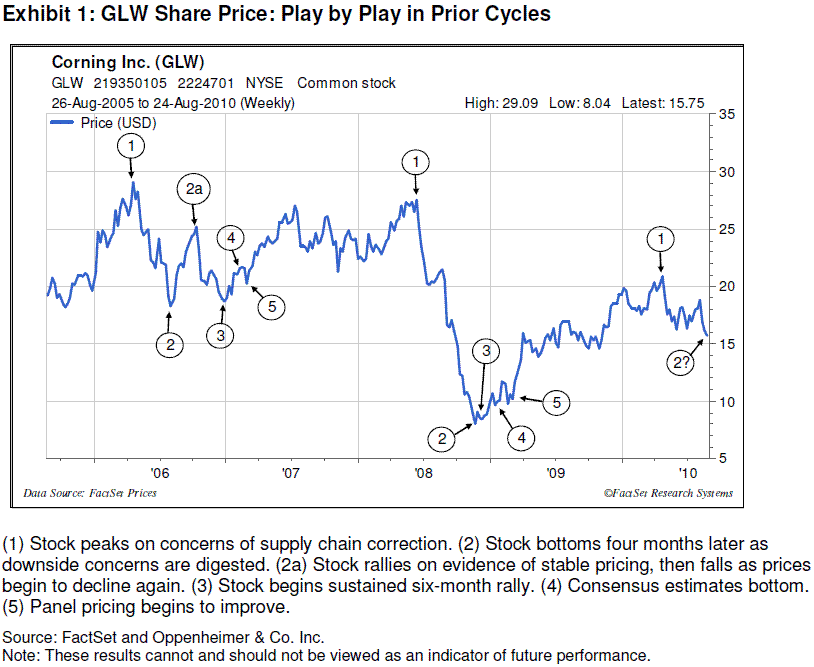
- Investors may be understandably nervous about stepping into GLW before the end of the inventory correction is in sight. But it pays to be early. During the last inventory correction, GLW's shares bottomed a month before panel prices found a floor, two months before estimates bottomed, and 3.5 months before industry fundamentals began improving.

- Because inventory cycles are driven by herd psychology as much as by supply and demand, it's tough to know when fear of shortage will swing into fear of glut, and then back again. The 2H09 inventory build overshot its mark in 1H10, and the current correction could err in the other direction.

- Slightly more predictable, however, is investors' ability to discount these inventory corrections. During the cycles of 2006 and 2008, it took investors approximately 4 months to fully discount the inventory correction and to become inured to incremental downward revisions. Approximately 4 months have passed since investors began to sniff a top to the current cycle.


Also worth noting: in each of the last two corrections, the bad news was digested and a sustained share recovery began (points 3 in the chart below) well before the Street had finished cutting estimates (points 4 in the chart below) and before improved LCD panel pricing had begun testifying to improved industry fundamentals (points 5 in the chart below).

In short, while Opco's call is almost certainly early from a fundamental point of view (insofar as industry fundamentals will take a bit longer to improve), it may not be too early from a stock point of view.

- Moreover, the current correction is likely to be much less severe than the prior one. Fear in the supply chain is not running nearly as high as in 2H08-1H09. And, unlike the last cycle, glass maker inventories are exceptionally low, which should mitigate the pressure to dump product.

Notablecalls: I'd say Yair Reiner from Oppenheimer carries weight in the space. He turned cautious on the LCD Panel space back in February, downgrading both GLW & AUO saying demand would peter out in Q1.

February 23: When Things Are Too Good to Last, They Don't
http://notablecalls.blogspot.com/2010/02/corning-nyseglw-when-things-are-too.html

And now he is reversing his call.

This LCD Panel cycle is closely tied major sports events like the soccer championship. Demand gets hyped up, estimates move up and once the event is in the rear-mirror, demand falls off from the elevated levels & everyone is oh-so-disappointed. After some months the cycle starts anew.

Same thing happening here.

I think GLW is a solid buy here. Goes to $16.25+ on this upgrade. It's not exactly a thin name so don't pay up too much in the pre market. Plenty of room to go long after the open.

Tuesday, August 10, 2010

Gone fishing...

Dear Readers,

It's been a while since my last vacation. I feel it's time.

I'm not exactly sure when I will be back. Hopefully in a couple of weeks.


Sincerely,


NC


PS: Tough mkt!

Navistar International (NYSE:NAV): Lowering target to $27 from $36, SELL - Morgan Joseph

Morgan Joseph's Charles E. Mitchell Rentschler is making a BOLD call on Navistar International (NYSE:NAV) lowering this target on the truck name to $27 from $36 while reiterating his Sell rating.

(Mind you, this is a $50 stock.)

Here are the details:

EGR Starts with "E"...as in Edsel
To the best of our knowledge, Navistar isn't making many more of its new engines than it was a couple of months ago. Using our trusty cars-in-the-parking lot "leading indicator" — we calculated last Friday (8/6/10) that there were 80-90 employees at the Huntsville MaxxForce 13-liter (actually 12.4) plant, which we believe translates into production of around 40 engines per day.

Our estimate triangulates with the Ward's report for July (the first month that NAV was bereft of 2007 CMI engines) of about 800, which also happens to suggest production of about 40 engines per day. This works out to an approximate 7% share of the Class 8 business, versus Navistar's share for all of 2009 of 28%, a dramatic decline that should leave Navistar shareholders wanting some explanation from management, in our view. If we allow that a quarter of last year's production was 15-liter (which NAV is not making now), this implies the company has actually lost about 67% of its 13-liter business (14/21).

Navistar's apparent significant market share loss is certainly not due to a decline in overall demand within the industry, which is strengthening (e.g., trade chatter is that Freightliner, belonging to Daimler-Benz, is sold out of its leading Cascadia model through the rest of 2010). But Navistar's loss could be the result of supply issues and/or quality problems; or it could be, as we believe, that truckers simply aren't buying the concept of EGR, which is inherently less fuel-efficient, not EPA-compliant, and not fully tested, in our opinion, and that it could experience serious warranty and reliability problems, in our view: In a word, an Edsel. We note that informed people in the industry we talk to (admittedly few have even seen a MaxxForce 13) are highly skeptical that it will fly.

Oh, to be Vertically-Integrated!
Almost everyone within the industry understands the urge to be vertically-integrated ("getting out of the nest"), which is, in our opinion, best done over time and with contingency plans, however...that's not the case with Navistar given there were no parallel paths or plans put in place, to our knowledge. Once all of the CMI 2007-certified engines were depleted, Navistar was on its own. SCR engines, with all of their paraphernalia, require far more truck-space and part-numbers. So, the SCR-ready tractor is substantially different from the EGR-ready tractor – meaning that it would take some time for Navistar to re-engineer its chassis to take SCR, if this is what Navistar chooses to do.

We understand, after speaking with one of our reputable industry sources, that, in fact, Cummins and Navistar are now jointly testing a Navistar ProStar truck with a Cummins SCR 15-liter (actually 14.9) diesel. The problem is, it was also suggested that it won't be ready for 4-6 months...after Navistar has agreed to this approach, which implies an effective start-time of around February 1, more or less, we think. But will Navistar's management actually do an about-face?

The Abyss, as an Alternative
If the company, on Tuesday, does not acknowledge it is peering into a gaping chasm as a result of its precipitous choice of EGR for 2010 engine technology, in our opinion, then all bets are off. Certainly, our estimates for 2010 and 20111 would be rendered "null and void." We'll try to divine the thrust of this scenario that afternoon, if necessary.

Rentschler's new estimates are for $0.50 for fiscal 3Q (ended 7/31) and $0.80 for fiscal 4Q (ending 10/31), revised down from $0.80 and $1.55, respectively, which translates into $1.95 for fiscal 2010 (down from $3.00 previously); he has also lowered his fiscal 2011 EPS estimate to $2.25, from $3.00 previously

The company has been guiding for $2.75-$3.25 for this year (no guidance provided, yet, for F2011), while the prevailing Street consensus is for F2010 EPS of $3.07 and F2011 EPS of $5.14.

These estimates assume Navistar stops building EGR motors ASAP and starts buying SCR engines from Cummins Inc. (CMI - $81.13 - NYSE; Buy), which suggests the company can begin to turn things around by February 1, 2011, or by Navistar's second fiscal quarter of next year.

Notablecalls: Once this call starts circling the desks, I think NAV will get hit.

Look at the chart.

Friday, August 06, 2010

Autodesk (NASDAQ:ADSK): Downgrade to Hold: Slowing Rate of Improvement Driven by EMEA - Jefferies

Jefferies is downgrading Autodesk (NASDAQ:ADKS) to Hold from Buy with a $31 price target (prev. $37).

Firm notes their recent channel work points to deceleration in EMEA, while North America remains strong. They are comfortable with their F2Q11 (July) ests and renewed Euro strength will help F3Q11 (October). But they think EPS revisions will moderate and the stock is unlikely to achieve a premium multiple under that scenario.

Key Points
Downgrading to HOLD as EMEA Trends Weaken. Jeffco's most recent survey/ checks point to some deteriorating demand in EMEA, while North American remains strong. EMEA is 40% of ADSK sales and therefore difficult to ignore. The data is not terrible, but it has paid to take note of inflections historically (e.g. negative in 01/08, positive in 07/09). Jefferies had also predicated their view on positive EPS revisions, which they now think will moderate.

No Change to F2Q11 Ests, Slight Raise to F3Q11 Given FX. Firm's survey work suggests 2% seq license growth for the July Q. After adj. for the April Q price change and for an est 3% negative seq impact from FX, their July ests remain broadly unchanged at rev/ NG EPS of $455M/ $0.26 vs Street at $456M/ $0.27 and guidance at $445-460M/ $0.25-0.28. Their survey suggests better sequential license for NA in F3Q11 vs a decline for EMEA, leading to a low single digit blended rate of growth. But at prevailing rates FX will add 1-2% to seq growth. As a result, they have bumped their October Q ests from $454M/ $0.29 to $468M/ $0.30 vs Street at $461M/ $0.29.

Improvement Trends are Moderating. Jefferies' channel survey data shows signs of moderation in the rate of change of improvement. LT growth expectations ticked down and around 1/2 the resellers saw improving overall demand trends versus 3/4 last survey.

Also Added Costs to FY12 to Reflect Merit Increases. They increased FY11 costs to reflect a small opex increase for merit payments that we think could be reinstated next year. This also modestly negatively impacts their FY11 EPS estimate and brings us more in-line with consensus on EPS.

Valuation/Risks
Jeffco's $31PT (from $37) is based on the stock trading on 17X our FY12 (CY11) EV/NOPAT at the end of FY11 (CY10) plus $6 net cash/ share. This multiple is broadly in line with the multiple for their group, and is lower tha prior 20X as they now have lower conviction on upside surprises to EPS. Key risks include the pace of new license sales recovery and the need to increase costs as rev growth increases.

Notablecalls: Jeffco's Systems Software team has made some good calls on ADSK in the past (e.g. negative in 01/08, positive in 07/09), which leads me to think today's call will get some attention. The target cut is also fairly hefty.

Monday, August 02, 2010

Linear Tech (NASDAQ:LLTC): Don't Eat the Yellow Snow..

Some interesting comments in Semi land this morning:

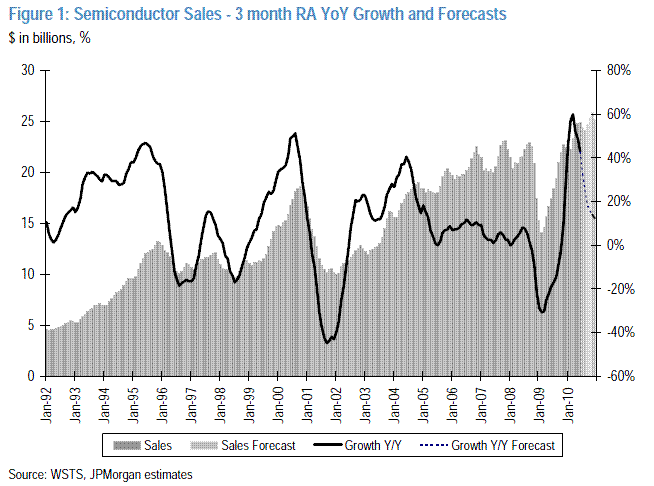
- J.P. Morgan notes that on August 1, the SIA announced June monthly sales of $27.2 billion or a MoM increase of 13.1%, well below the average June MoM increase of 20.8% and well below their estimate of a 20.8% MoM increase or $29.0 billion. The three-month rolling average sales for April-June increased 42.6% YoY to $24.9 billion, below our estimate of $25.5 billion.

Weakness in June was broad based, with microprocessors, flash, and DSP chips exhibiting the lowest MoM revenue growth relative to their seasonal norms. As the figure below illustrates, JPM believes the 3 month rolling average YoY revenue growth in 2010 peaked in March at 60% and will trend down to a trough of 12% in December as the easy comps in 1Q10 go away.


Still cautious on semis – hide in defensive stocks. JPM continues to be cautious on semiconductor stocks as we are seeing several signs of softening demand for technology products across the globe. Their top pick continues to be Overweight rated Linear Technology (LLTC), firm's semiconductor “igloo”.

Not time to “buy semis because the downturn is already priced in.” JPM believes the semiconductor sector is exhibiting the classic first signs of a correction – lead times being reduced and bookings dropping. For the first time since the previous downturn, we are witnessing several instances of semiconductor companies missing estimates and/or lowering guidance. Since the downside to estimates during a downturn is usually underestimated, they do not believe the downturn is priced into semiconductor stocks.

- Amusingly, Merrill Lynch/BAC is out this morning trying to blow up JPM's "igloo" by downgrading Linear Tech (NASDAQ:LLTC) to Underperform from Neutral with a $30 price target (prev. $33).

Their cautious stance is predicated primarily on intermediate term risks in the industrial and auto segments, with our analysis suggesting a sizeable overshoot in shipments vs. true demand/consumption. Further, they see risk of commoditization of high end computing designs, a driver of recent and anticipated growth.

Overstaying its welcome at the Industrial party
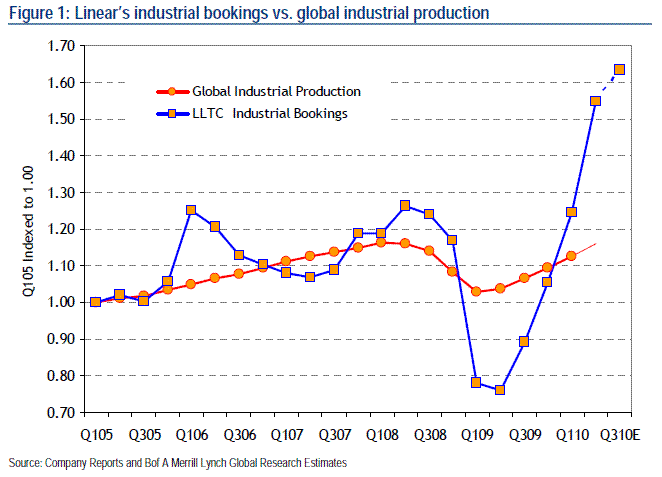
Although late to the party, Linear has in recent qtrs benefited from the recovery in the industrial segment, with bookings in this segment (37% of total bookings) up 104% from the lows. The good news in Merrill's view ends here, as current bookings - at a level that is 23% above the prior qtrly peak run rate - represent an overshoot vs. actual demand as implied by global industrial production, with the latter only just about reverting to prior peak levels. Firm thinks this overshoot is the result of extended lead times and perceptions around capacity constraints. A mean reversion (and possibly an undershoot) is likely to compensate for this overshoot, thus setting the stage for an inventory correction in this segment in coming qtrs.


Autos poised to run out of gas
A similar story, they think, exists in the auto segment where orders seem to be well above levels supported by auto production trends. While we concede that some of this growth is driven by silicon content growth in autos (a secular theme) they view the discrepancy between Linear’s auto bookings and global auto production as too large to be simply attributed to content growth.

Reducing estimates
While Merrill expects an upward bias to near-term ests fueled in part by a continued inventory overshoot given supply constraints/extended lead times, they think the longer this dynamic persists the greater the risk to estimates. PO moves to $30 from $33 or 13x Merrill's CY11E EPS; their already sub consensus FY12 EPS est. also trickles lower.


- Baird's Semi team is downgrading a host of names (DIOD/FCS/ONNN/STM/TXN/MU) saying inflection point in lead times occured last week.


While remaining above normal, lead times at large worldwide distributors fell sharply last week for the first time this year. Baird's recent checks point to reduced back-end revenue outlooks for 3Q, lower visibility across the technology supply chain, along with ongoing reductions in component orders from tier-one PC OEMs

Baird's downgrade of several analog semiconductor companies reflects their belief falling lead times will lead not only to a steep fall in backlog, but also eventually to order cancellations which could impact 4Q10/1Q11.

Notablecalls: With Merrill pissing on JPM's igloo saying bookings are in for a big correction & Baird basically backing the same view, I think LLTC is a short.

As grand master Frank Zappa said: Don't Eat The Yellow Snow.

I would also keep the Baird downgrades on radar. Would short Texas Instruments (NYSE:TXN). This puppy is losing steam, it seems.